
Background
The number of children diagnosed with certain developmental delays has been steadily increasing in Singapore over the past few years since 2010.
Yet, many Singaporeans are unaware of the different disabilities one can be diagnosed with, let alone their challenges and needs. This potentially leaves families and people with disabilities feeling isolated and alienated from our society.
Many of their stories have become lost in a society that moves at a breakneck speed.
This is one such story we wish to share.
Against all odds, life and love always finds a way...

Meeting Rachael
Upon stepping into Rae’s home for the first time, we were struck by the absence of ordinary-sized furniture in her living room. On one end stood a low wooden table, while a tall multi-coloured chair sat on the other.
Lying on a playmat was her daughter, Rachael Mok, who played with her toy car keys whilst surrounded by all her other favourite toys.
Ms. Rae Mok, 45, and Mr. Ryan Ngan, 49, are the parents of Rachael, a girl diagnosed with a chromosome disorder.
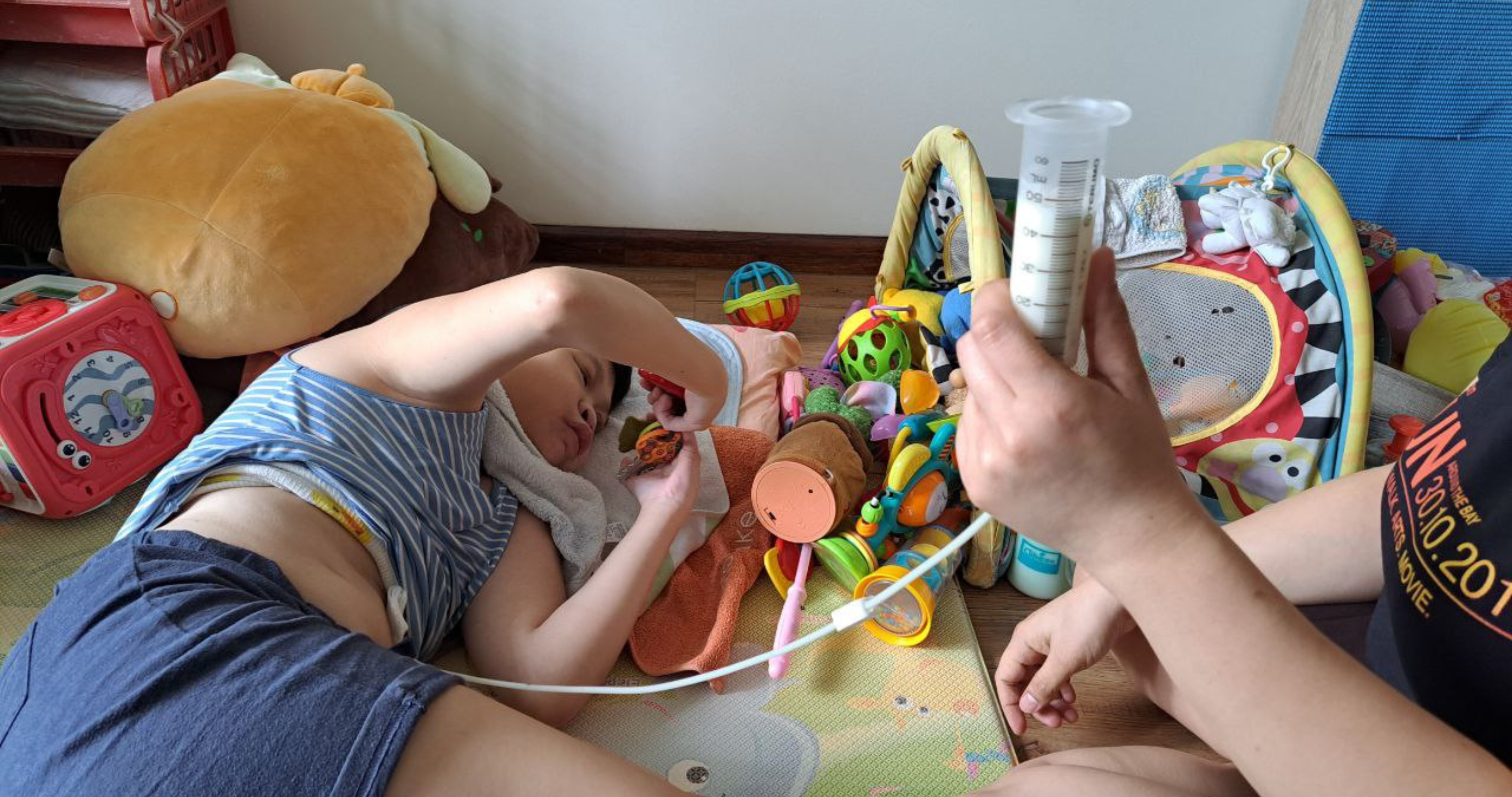
She was born with a myriad of medical conditions, including a heart condition, a cleft palate, and a global development delay.
Rachael cannot talk, walk, or eat, and is fed infant milk and cereal through a feeding tube connected to her stomach.
Tube feeding connected to Rachael's stomach
Rachael's cleft palate
Although Rachael has recently turned 18 in October, her mental capacity is still that of a six-month-old baby, Rae says. And while this milestone is cause for celebration – as evidenced by the balloons in the corners around their house, Rachael’s graduation from adolescence also means that her parents will have to look for another school to enroll her in. This is because Rainbow Center, Rachael’s current school, only accepts children up to 18 years old.
Education with Disabilities


Since she was two and a half years old, Rachael has attended Rainbow Center, a special education school catering to students with moderate to severe disabilities and who require additional learning support. For the past 16 years, the school has provided Rachael with a nurturing and loving environment where she has gotten the ‘full suite of services’.
“She loves the activities and it is very sad for her to have to graduate.”
Rachael's Life Expectancy
Before Rachael’s birth, the parents-to-be were unaware of any medical conditions present in their unborn baby. The only visible abnormality picked up by the ultrasound scan was her unusually-sized heart. But after a discussion with her gynaecologist, Rae was not advised to do further checks as it did not seem serious enough.
Rae only found out that Rachael was born with chromosome disorder the morning after her long labor, where an emergency C-section was carried out.
"My husband came to tell me that our child has some deformities, and from the deformities, the doctors suspected she had something called Trisomy-13… at birth, she was only given two weeks to live.”
The parents were overwhelmed, thinking they would only have two weeks to spend with their daughter. While mothers who undergo C-sections usually take about six weeks to recover, Rae forced herself to walk to the hospital just to see Rachael.
“We were just going in and out of the hospital trying to spend as much time as we could, thinking that she would probably not be around for very long.”
At one stage in her life, Rachael was seeing eleven doctors and three therapists. Going in and out of the hospital as frequently as they did exerted an emotional toll on Rae, who once broke down after feeding Rachael at the hospital.
“I was trying to feed her but she was making a lot of fuss… and everybody was staring at us. After that, I went to the toilet to cry because I could feel all eyes on me, and yet I couldn’t handle her,” Rae says.
Thankfully, Rae received valuable medical and emotional support from the medical staff at KKH as well as her loved ones.
“When we were there, we felt very well taken care of… they treated us like family. The other very important thing is that both sides of the family accepted her immediately… everybody loved her equally as any other grandchild in the family”
The Financial Difficulties
Coming from a middle-income family in Singapore, Rae and Ryan found it difficult to handle the heavy financial burden imposed by the many operations as well as exercise and medical equipment required for Rachael.
“Although we could submit enough documents to prove that our expenses were way higher than our double income… we didn’t qualify for any subsidies, any assistance,” Rae says.
To cope with the high costs of Rachael’s numerous operations as well as hiring a helper, the family sold their furniture and rarely-worn clothes. Eventually, they sold their five-room flat to move into a three-room flat. This decision was made after knowing that one’s flat size determines how much assistance one can receive from the government.
Government organizations such as the Ministry of Social and Family Development (MSF) and Agency for Integrated Care (AIC) allow caregivers such as Rae to apply for subsidies to aid in taking care of family members such as Rachael.
Though such organizations are undoubtedly helpful, Rae says as someone who has dealt directly with them for assistance, they have areas for improvement.
Upon Rachael turning 16, support from MSF was immediately cut without warning.
The parents then had to apply under AIC, having to go through the process of getting medical records and doctor’s notes all over again. Because AIC mainly caters to persons who became handicapped as adults, there is little support for someone in Rachael’s position who was born handicapped and is transitioning into adulthood.
The Emotional Difficulties
Moving into their current four-room HDB flat in Toa Payoh, Rae worried about how the many young families in the vicinity would feel about their children growing up around Rachael. Reassuringly, their neighbours were accepting of and warmhearted towards Rachael. Even though their children cannot verbally communicate with Rachael, they are taught to greet her and play with her.
At KKH, Rae recounts her many experiences in interacting with other parents.
“There was one parent who… cried after I shared about Rachael because she had been very very upset with her daughter having on-off fever, and she couldn’t go to work. [She said] Rachael is so sick, and yet I was being the cheerful one, so she felt that she had very little to complain [about]”

Although she has not received many mean words, fellow caregivers have faced unfortunate encounters with the public. One case involves Rachael’s classmate, whose face is deformed.
“When the mother took a bus with the child, there was an elderly lady who told her grandchild: ‘You don’t go and touch him, later your face also become like that!’” Ms Rae recalls.
“So then she never took the bus ever again, because she was so hurt”, says Ms Rae about her fellow parent.
While ugly moments like this cannot be foreseen, Rae strongly believes this is only in the minority of cases and most people are empathetic and friendly to parents with special needs kids.
The Community Support Available
In the past couple of decades, Rae notes that while there is still room for improvement, Singapore is a lot more handicapped-friendly than in 2004 when her daughter was born. Today, many organizations and communities have sprung up to support persons with special needs and their families. Ms Rae herself, wanting to make a difference for families with special needs children, started Project Give. This non-profit organization creates an inclusive community for special needs families and connects families to special needs caregivers. They organize home visits and tea parties for kids with chronic illnesses.
Apart from special education (SPED) schools in Singapore, there are also day activity centers for persons with disabilities, such as SUN-DAC, a non-profit social service agency.

Home visits carried out by Project Give
Home visits carried out by Project Give

Festivities at SUN-DAC
Festivities at SUN-DAC
Ms Stephanie Alakesan.
To better understand what organisations are doing to help youths with special needs, we spoke with Ms. Stephanie Alakesan, a special needs educator from Fei Yue Community Services. She helps run the Early Intervention Programme for Infants and Children (EIPIC), which aims to help children from birth to the age of 6 years old, through social, educational, and rehabilitative means.
When it comes to interacting with people that have special needs, there are times that we as a society have fallen short in terms of being supportive and respectful. For instance, the recent case where a worker at the fast food chain Burger King was seen scolding a coworker who had special needs.
To create a more supportive environment for people with special needs and prevent future similar incidents, Stephanie believes that the public needs to be educated on the different types of special needs and the behaviours such people may exhibit. We as a society also need to be more proactive in speaking up for those with special needs.
In her view, while teachers are called upon to educate children with special needs, the responsibility of educating the minds of society belongs to us, as young people. Teaching people that special needs children are different, but that does not warrant ostracization, nasty remarks, or any other negative treatment. Stephanies applauds the families and children with special needs who muster every ounce of faith and battle within themselves in order to believe everything will work out in the end despite a world that does not wait for anyone.
What does the future hold?
When asked what words of advice she might have for parents of special needs children, Rae responded,
"Things will not be ok, but you will be ok,"
reassuring fellow caregivers that despite the difficulties, there are resources available and they just need to reach out to the community for support.
Rae points out that rather than reach out, many new parents choose to research on their own. But with the overabundance of information on the Internet, they struggle with their diagnoses which makes them more confused and scared. “With whoever I reach out to, [I hope] that they can take that route and not go down the difficult path that we have gone down. I like to say that then it gives more meaning to her existence because I also try to [understand] why she was born to this earth, why she didn’t pass away after 18 years, why I was chosen to be her caregiver,” she says.
Awareness is a lot about reminders. While we all inherently know that we need to help others, it often takes a little push for us to be more accommodating to those with special needs in our community. Rae illustrates this most vividly in her example of bringing Rachael out on walks. “Sometimes, I come across paths that I need to carry her. I can just stand there and nobody will ask ‘Do you need help?’. But all I need to do is [ask] ‘Sorry, can you help me?’, and everybody will help. Hundred per cent.”
Heart-wrenchingly, Mr Ryan and Ms Rae’s only wish is for Rachael to go before them.
“I think about her funeral arrangements all the time… we are very scared that the day doesn’t come before us because then we don’t know what will happen to her,”
Weathering the profound challenges over the past 18 years, the Mok family’s story is one of tremendous resilience and love, illustrating much we can do for the differently-abled in our community. As Stephanie says, there is a need for our society to change their perceptions of people with special needs and see them as people who have extra needs, rather than being different from us and “not normal”. In creating a more inclusive and considerate society, we must acknowledge our duty to lend a helping hand whenever we can.
References
Yeo, S. (2021, September 13). More young kids diagnosed with developmental delays in Singapore. The Straits Times. Retrieved October 16, 2022, from https://www.straitstimes.com/singapore/parenting-education/more-young-kids-diagnosed-with-developmental-delays-in-spore.
YouTube. (2019). Rare Disease Diagnosis Patient Journey. YouTube. Retrieved October 22, 2022, from https://www.youtube.com/watch?v=qa81xBsEuO4.
