
Female athletes feel failed by their sportswear
Exploring how sports bras and football boots are ill-fitting for female athletic use
In recent years, the popularity of women’s sports has skyrocketed, with significant growth year after year. In 2024, according to a new Women’s Sport Trust report, women’s sport in the UK achieved its most-watched year ever, with 44.7 million viewers tuning in. Female athletes are finally getting the recognition they deserve and are helping to inspire a new generation of young girls to get active.
With more media coverage, more female athlete role models and more backing by big brands, in many ways, female sport has taken a huge leap forward.
However, one area of the sporting world still lacking for women is the availability of adequate sports kit properly tailored to the needs of a female athlete. Much of the current sportswear on the market fails to meet the unique needs of women and those that do are often prohibitively expensive.
From football boots primarily designed for men to sports bras that are ill-fitting, much of the apparel available is not only limiting performance but could also lead to injuries.
Sports bras
One area where sportswear continues to fall short for female athletes is in the design of sports bras.
If you were to go online and search for ‘sports bras’, you’d find many retailers selling their version of the product. From Nike to Adidas to Calvin Klein, there are seemingly plenty of good, trustworthy options to choose from.
However, recent research and athlete experiences suggest many sports bras on the market aren’t accessible, supportive or comfortable enough for women when exercising.
In fact, Dr. Jess Pinchbeck, an academic from the Open University, states that 80% of women wear sports bras that don't fit properly.
The issues with wearing an inadequate sports bra
Douglas Powell, associate professor in the College of Health Sciences at the University of Memphis and founder and director of the Breast Biomechanics Research Centre, has been studying the impact on female athletes when not wearing a properly supportive sports bra.
Powell's initial foray into this area of study began in 2022 after one of his master's students refused to run on a treadmill without her preferred supportive sports bra.
Confused as to why this would be a hindrance to exercising, he turned to online research, only to be surprised by the lack of substantial information available on the topic. So, he began researching for himself.
He said: “In our first set of studies we had a girl who was a G cup do running, jumping and landing and changing direction in what we would consider to be a standard sports bra and then again in a bra from ‘She Fit’ which are a small company out of Hudson, Michigan.
“She went from around 15 centimetres of vertical breast movement when landing, down to two centimetres, and so wearing the She Fit bra almost eliminated breast motion in a very large-breasted woman.”
By wearing a properly supportive sports bra, athletes can significantly reduce this movement and thus their risk of injury. The She Fit product shows the significant impact wearing a supportive bra has on protecting the health of athletes' breasts.
A sports bra being prepared to be analysed. Photo credit: Tara Vooght from The Research Group in Breast Health at Portsmouth University
A sports bra being prepared to be analysed. Photo credit: Tara Vooght from The Research Group in Breast Health at Portsmouth University
Research then moved on to look at whether a more supportive sports bra can influence sporting performance. A female athlete's oxygen consumption, while running on a treadmill, was measured and compared while wearing a Puma sports bra and then the She Fit bra.
It was concluded that when the athlete used the She Fit bra, she consumed 7% less oxygen than when she wore the Puma Bra.
Douglas explained why wearing a more supportive bra would decrease oxygen consumption and why this is beneficial to performance.
He said: “As we run, we start to release energy through tissue vibration. If you have an uncontrolled breast because of a lack of support, that tissue has a greater capacity to vibrate.
“So, as you run and this vibration occurs, you start to lose energy and so must work harder to run, which comes out as a greater oxygen cost.
“A more supportive bra correlates with an improvement in oxygen consumption.
“Your brain also has to focus on this oxygen problem, as opposed to your performance, which in itself inhibits your ability to run as well as you can.”
The effectiveness of a sports bra being examined during a running test. Photo credit: Tara Vooght from The Research Group in Breast Health at Portsmouth University
The effectiveness of a sports bra being examined during a running test. Photo credit: Tara Vooght from The Research Group in Breast Health at Portsmouth University
Tara Vooght, 22, a researcher at the Research Group in Breast Health at Portsmouth University, is also part of a group looking at the impact ill-fitted bras have on female athletes.
She said: “Female discomfort is one of the biggest things we have noticed in women wearing a sports bra that’s not properly supportive.
“Straps start to dig into their shoulders because they’re trying to support all their boob weight on a thin strap surface area, smaller than what they need.
“Over a period of time, breasts will start to sag if you’re not supporting the tissue as the skin starts to stretch because of the weight.
“There are plenty of sports bras that shouldn’t be marketed as such, but there’s no regulation for what can be counted as a sports bra.”
Even Puma, one of the world's leading and most popular sportswear brands, producing similar quality and priced products to those of Nike and Adidas, produced sub-optimal outcomes for the female athlete in Powell's study.
When you think about all the numerous other brands on the market, not as notable as Puma but also claiming their sports bras to be optimal, it becomes clear just how many women may be wearing ill-fitting bras.
Sophie Coldwell
Team GB triathlete
Sophie Coldwell, 30, is a professional triathlete for Team GB. Raised in Nottingham and now living in Loughborough, Sophie has been competing in triathlons since the age of eight years old.
“I was always an active kid, I was always taking part in swim lessons and stuff like that at school. Then my mom just saw a local kids' triathlon advertised at Clifton in Nottingham. So, we went down and had a look, and it's kind of just snowballed from there really.”
Her youth career was marked by success, as she won junior and U23 medals at the international level before making her breakthrough into senior competitions in 2017.
Sophie’s career has taken her racing around the world, with competitions in countries like Canada, the United Arab Emirates and Bermuda. Notable achievements include clinching 1st place at the 2023 World Triathlon Championship Series in Yokohama and securing 1st in the mixed relay at the 2022 Birmingham Commonwealth Games.
A self-proclaimed ‘small-breasted woman’, Sophie had never, up until recently, found issues with her sports bras.
“In all honesty, up until the back end of last year, I fell into the very small boob category. So, finding a sports bra that was supportive enough was never a huge issue.
“I would buy very much off the shelf, very standard crop tops, not like a clasped fitting, no extendable straps or anything like that. It was just a very standard crop top, and that was absolutely fine.”

Sophie Coldwell enjoying a scenic run while on holiday. Photo credit: Sophie Coldwell
Sophie Coldwell enjoying a scenic run while on holiday. Photo credit: Sophie Coldwell

Sophie Coldwell testing her biking capabilities in the mountains. Photo credit: Sophie Coldwell
Sophie Coldwell testing her biking capabilities in the mountains. Photo credit: Sophie Coldwell

Sophie Coldwell poses during a bike ride with friends. Photo credit: Sophie Coldwell
Sophie Coldwell poses during a bike ride with friends. Photo credit: Sophie Coldwell
However, since falling pregnant, Sophie's relationship with sports bras has completely changed.
“I can’t just wear what I have been before. My ribs have expanded so much that the bras I’ve been wearing are now so tight around my rib cage, it feels as if I can't breathe.
“Because my boobs have obviously gotten bigger, and they've been super sensitive, there’s just not enough support in the bras.”
Sophie has found, since her breasts have grown, that the bras she has purchased have not been supportive enough for her sporting needs, resulting in countless of online orders being sent back.
“Sports bras are just quite inaccessible for the majority of people, the options aren’t great."
Knowing that she plans to breastfeed after giving birth, Sophie isn’t willing to settle when it comes to choosing a sports bra. She understands now more than ever the importance of wearing a supportive bra to maintain her breast health.
However, to wear something supportive, she feels she is forced to neglect her comfort.
“What I’ve found is that the bras I've looked into fall into two categories in my mind. One is your standard bra, where you do it up from the back with the hook and clasp, which I just find super uncomfortable.
“It’s just sat on your spine, and when I’m either running, or I'm bent over on the bike, it really rubs, so that's really annoying, and I hate it, I’ll be honest.
“Then you have your standard crop tops that are just elastic, but they’re obviously not very supportive.”
As an ASICS-sponsored athlete, Sophie feels very fortunate to be in the position of being sent kit to wear. However, now that her breasts have grown and her sportswear no longer fits, she has become acutely aware of the lack of accessible, well-fitting sports bras on the market.
“It’s just been very eye-opening for someone who has been very fortunate to just get sent kit to wear, and it fits. I've never had to think about things fitting until now.
“I'm very conscious of fast fashion and stuff, you know, like SHEIN and Temu. They pop up selling sports bras worth like £10, and obviously I don't really want that as I know it’s not going to be of any quality.
“But then you more classic sports brands you could be paying upwards of £50 just for one bra, and that price nearly kills me.
"Sports bras are just quite inaccessible for the majority of people, the options aren’t great, and to be honest, I think a lot of us just don’t know what we should look for.”
In addition to the issues of finding a bra that is supportive, comfortable and inexpensive, Sophie has also struggled with finding a product designed to help prevent chafing.
“The done thing to do is wear a sports bra underneath the tri suit, and obviously they’re not designed for that, so they can hold quite a lot of water, which has been an issue.
“Also, if it rains and you're wet, or it's really hot and you're really sweaty, then they rub where the band is or under your armpit, it catches the inside of your arm.”
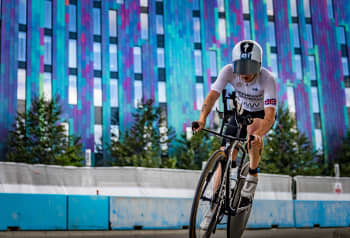
Sophie Coldwell competing at the London T100 pro triathlon race. Photo credit: London T100 triathlon. Photo credit: London T100 triathlon
Sophie Coldwell competing at the London T100 pro triathlon race. Photo credit: London T100 triathlon. Photo credit: London T100 triathlon
Sophie Coldwell competing at the London T100 pro triathlon race. Photo credit: London T100 triathlon. Photo credit: London T100 triathlon
Sophie Coldwell competing at the London T100 pro triathlon race. Photo credit: London T100 triathlon. Photo credit: London T100 triathlon
Sophie Coldwell competing at the London T100 pro triathlon race. Photo credit: London T100 triathlon. Photo credit: London T100 triathlon
Sophie Coldwell competing at the London T100 pro triathlon race. Photo credit: London T100 triathlon. Photo credit: London T100 triathlon
Sophie Coldwell competing at the London T100 pro triathlon race. Photo credit: London T100 triathlon. Photo credit: London T100 triathlon
Sophie Coldwell competing at the London T100 pro triathlon race. Photo credit: London T100 triathlon. Photo credit: London T100 triathlon
Karyna Manuel
Personal trainer, sailing coach and former Team GB sailor
Another athlete no stranger to the complexities and issues with sports bras, is Karyna Manuel.
Karyna, 28, competed for Team GB in sailing from 2009 to 2016 and now works as a sailing coach and personal trainer.
Having always led an active lifestyle, the issues she has faced with sports bras have been extensive.
From chafing to restrictiveness, finding a sports bra that offers a balance between comfort and support has been a constant problem for Karyna.
She believes sports bras on the market are a generic style and don't cater for the different sizes and athletic needs of women.
Karyna doing lunges in the gym in between PT classes. Photo credit: Molly Sutherland
Karyna doing lunges in the gym in between PT classes. Photo credit: Molly Sutherland

Swijin bras
One up-and-coming sportswear brand that has recognised the challenges with sports bras and believes it has a solution for female athletes is Swijin.
The Swiss brand was founded by Claudia Glass, 50, after she realised, whilst on holiday, that the sports bras she owned were inadequate for use on both land and in water.
Seeing there was nothing of such on the market, Claudia set out to create the bra herself.
“I was on vacation, and I would spend my mornings running down to the ocean with just a regular sports bra on from Nike, and I was so desperate to combine my run with a swim.
“I thought, wouldn't it be nice to have a sports bra that acts as a sports bra on land, but as a swimsuit in the water.
“When I got back to Switzerland, I got in touch with the Swiss Federal Laboratories for Materials Science and Technology and spoke to the scientists who said this would be really hard to build, and so I applied for a research grant for them to help me make it.”
By partnering with scientists and textile engineers, Claudia started to innovate a high-tech, fast-drying fabric suitable for both land and water use.
One of the first prototypes of 'The Freeli' sports bra. Photo credit: Claudia Glass
One of the first prototypes of 'The Freeli' sports bra. Photo credit: Claudia Glass
As the product began to be built, the Swiss Athletics Federation, which is the governing body for the sport of athletics in Switzerland, informed Claudia of the issues female athletes were having with sports bras in general.
“They came to visit us at the laboratories, and they said all the pro athletes are still suffering as there's no real, proper, good sports bra that solves all the problems in one product.
“It's like they're either good at stability, but then they suck because they're too constrictive or they don't dry fast enough.
“And so, we didn't want to just build a product that was sort of just mediocre, we wanted to be able to do it all.”
As stated on their website, Swijin is ‘the world’s first and only sports bra for pro athletes,’ and currently offers two bras for sale. ‘The Freeli’, designed for medium-impact exercise, and ‘The Schnuggi’, made for high-intensity workouts.
'The Freeli' and 'The Schnuggi' sports bras. Picture credit: Claudia Glass
'The Freeli' and 'The Schnuggi' sports bras. Picture credit: Claudia Glass

Founder of Swijin bras, Claudia Glass, 50, in her 'Freeli' sports bra. Photo credit: Swiss Textiles
Founder of Swijin bras, Claudia Glass, 50, in her 'Freeli' sports bra. Photo credit: Swiss Textiles

Keen runner Claudia, getting ready to go running after her swim. Photo credit: Swiss Textiles
Keen runner Claudia, getting ready to go running after her swim. Photo credit: Swiss Textiles
As a competitive runner herself, Claudia truly understands the needs of female athletes when it comes to sports bras and has taken pride in crafting a product that meets all the essential requirements.
“We have eliminated sewing machines from the manufacturing process and only work with people who specialise in what's called ultrasonic welding and bonding, so that we get no digging seams that can cause women chafing issues.
“We're also working with a double strap system so that the impact when running is no longer on the shoulders but is relocated to be absorbed across the back.
“Our fabric, however, for our high-intensity bras is our foundation.”
The fabric is made from a polyamide sourced from the oil of a castor bean from India. The oil is pressed and shipped to France, where it's transformed into pellets. These pellets are then turned into yarn in Italy and sent to Austria, where they are knitted into the fabric used for the bras.
Swijin bras are created from a polyamide sourced from the oil of a castor bean from Pragati castor plantations in Gujarat, India. Photo credit: Claudia Glass
Swijin bras are created from a polyamide sourced from the oil of a castor bean from Pragati castor plantations in Gujarat, India. Photo credit: Claudia Glass
Claudia Glass outside Pragati castor plantations in Gujarat, India. Photo credit: Claudia Glass
Claudia Glass outside Pragati castor plantations in Gujarat, India. Photo credit: Claudia Glass
An intricate process, producing super lightweight and very fast-drying fabric that absorbs very little water. This is crucial for preventing chafing injuries as well as helping with the comfort of the athlete.
Throughout the development of Swijin bras, Claudia knew it was important to stay in tune with the needs of real athletes. She tested every new prototype on pro athletes, gathering their feedback to understand areas that needed improvement.
The bras are loved by athletes, frequently selling out and being chosen to wear by professional sports teams, such as the women’s football teams Paris FC and the Swiss team FC Aarau.
Swijin is a positive step forward for female athletes, but Claudia recognises that there is still much more progress to be made in the development of women's sports apparel.
Swiss football team FC Aarau kitted out in Swijin bras. Photo credit: Claudia Glass
Swiss football team FC Aarau kitted out in Swijin bras. Photo credit: Claudia Glass
“You’ve got all these brands that you see out there that are typically made for men, like Puma, Adidas, Nike, and they’re all investing heavily in male sport and male athletes.
“We don't have a female company, and so there’s such a white space when it comes to women’s kit and how it can affect their performance and health.
“This issue still needs so much more research and development.”
Although an exceptional product for the future of female athletes, the bras retail, depending on the product you choose, at either £75 or £90. A high price, and one that likely makes it inaccessible to many female athletes.
While the bra provides excellent support, comfort and adaptability, it still falls short when it comes to being accessible to a wider population.
Expert advice on buying sports bras
Navigating the sports bra market can be challenging. There are many options available, and the risk of discomfort or injury if the wrong one is chosen.
While many products fall short of meeting the needs of female athletes, there are still ways to reduce the chances of selecting an ill-fitting sports bra.
Tara Vooght, 22, a researcher at the Research Group in Breast Health at Portsmouth University, hosts online workshops twice a year, offering the public a chance to learn directly from experts about breast anatomy, biomechanics, and how to choose the right sports bra.
She believes any woman in sport must be measured professionally before they buy a sports bra.
Tara Vooght, 22, researcher at the Research Group in Breast Health at Portsmouth University. Photo credit: Tara Vooght
Tara Vooght, 22, researcher at the Research Group in Breast Health at Portsmouth University. Photo credit: Tara Vooght
She said: “I think everyone should have access to a place where they can get their breast measured, and I would really encourage them to do so because a lot of women are just guessing at their size.
“I just don’t think the general public or even athletes necessarily have that understanding of what’s right for them, but to change this, it starts with knowing your size.”
When it comes to choosing a sports bra, Tara also has some key suggestions of things to look out for.
“For someone with bigger boobs, you’re going to want to look out for products with a thicker shoulder strap or a thicker under band to carry that larger mass.
“You also don’t want a sports bra to restrict your breathing, so although it should fit tighter, a rule of thumb is to make sure you can fit two fingers between your shoulders and the straps.”
Tara encourages any female athlete to get their breasts measured before buying a sports bra. Photo Credit: Molly Sutherland
Tara encourages any female athlete to get their breasts measured before buying a sports bra. Photo Credit: Molly Sutherland
Tara also emphasises the importance of ensuring the under-band or wire sits flat against your ribcage, and that the fabric of the cup should remain smooth. Any wrinkles in the fabric typically signal that the cup is too large.
Additionally, she notes that after around 20 washes, some components of the bra may begin to wear out, losing their original shape and support. This is an important consideration when thinking about when to replace your sports bras.
Football boots
Another overlooked area of women’s apparel is football boots.
The European Club Association’s high-performance advisory group recently conducted a survey involving 350 female football players across Europe and found that 82% regularly experience discomfort while wearing football boots.
The research also revealed that most football boots currently available are primarily designed with a male’s foot shape in mind.
The issues with football boots on the market for women
Women’s and men’s feet are very different.
Women in general have a narrower foot and a higher arch than men. They also have a shallower big toe, a lower instep and a more curved inside line.
The way women walk is even different. Women tend to take shorter, more frequent strides and are also more likely to roll their feet inward.
For boots to be properly tailored to each gender, it’s clear there should be specific modifications to cater for these differences.
Yet, a recent review by Katrine Kryger, an Associate Professor in Sports Medicine at St Mary's University, revealed that only 32 scientific articles had explored technology in women’s football.
So, women have been left to use gear, including boots, designed predominantly for men.
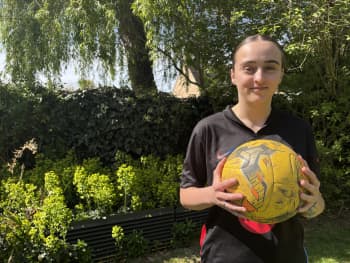
Most football boots on the market aren't made for female feet. Photo credit: Juliette Willows
Most football boots on the market aren't made for female feet. Photo credit: Juliette Willows
Fabio Mancino, 34, is an Arthroplasty fellow at Fremantle Hospital and Health Service in Australia and has been looking at the impact wearing male football boots can have on female athletes.
He said: “Women wearing boots made for men are going to be uncomfortable as they have differently shaped feet.
“They run differently, they use different types of muscles, and so they need different types of support.
“They won't get optimal support using a boot that’s designed for men, the shoe will be too wide and won’t fit them properly on their arch, which can cause heel pain, calluses, blisters, the lot.”
Along with issues of blisters and a lack of comfort, Fabio insists that there are some more serious consequences for female athletes wearing male football boots.
Running in ill-fitted football boots can cause rubbing, blisters and other injuries for women. Photo credit: Juliette Willows
Running in ill-fitted football boots can cause rubbing, blisters and other injuries for women. Photo credit: Juliette Willows
“There is credible reason to believe that extrinsic factors like wearing male football boots can increase a woman's chance of ACL injuries.
“This is mainly because the length of the studs and where they’re placed on the boots are designed for male running and traction. But for women, this stud placement can cause their foot to get stuck in the pitch and their knee to twist because of this.
“There are so many anatomical risk factors women have which make them more prone to ACL injuries than men, but things like wearing football boots not designed for the needs of their feet is an added risk factor we can reduce.
“I think everything starts with more attention, and as female sport is growing, this problem needs to be identified and fixed.”
Shaney Bond
Footballer for Tranmere Rovers FC
One athlete who has first-hand experience with the issues football boots on the market are causing female athletes is Shaney Bond.
Shaney, 22, from Wolverhampton, currently plays for Tranmere Rovers FC.
She first joined an all-boys team where she remembers wanting to fit in by wearing the same football boots as everyone else.
She said: “I remember joining the local side with all the boys from school, and, where I was kind of new to the sport, I wanted to copy the football boots they had on.
“At that age, I don’t remember having any issue with football boots.”
Shaney Bond training for Tranmere Rovers FC. Photo credit: Joseph Stanley
Shaney Bond training for Tranmere Rovers FC. Photo credit: Joseph Stanley
According to Kirsti Mann from Highett Podiatry, male and female feet exhibit similar growth patterns in the initial stages of development.
It’s only with the onset of puberty that significant differences in foot development begin to emerge, marking a turning point in the way foot growth progresses between the sexes.
As Shaney advanced through her career and got older, she began noticing issues with the football boots she was wearing.
“I used to get really awful blisters, especially when first wearing a pair of boots.
“They’d be all on my ankles and toes and would be so bad that sometimes I would have to be subbed off during games.”
This led Shaney on a path of trying to find a football boot that wouldn’t cause her pain, repeatedly ordering different models from various websites.
However, whether the boot was from Nike, Adidas, or another top sports brand, she kept running into the same issues.
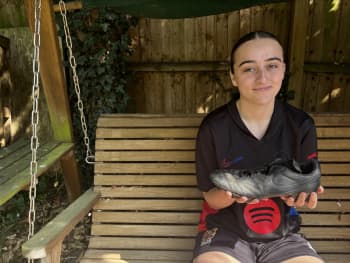
Shaney now uses a Nike model, having tried many boots on the market. Photo credit: Molly Sutherland
Shaney now uses a Nike model, having tried many boots on the market. Photo credit: Molly Sutherland
“Honestly, up until a couple of years ago, I must have been ordering like three different pairs of boots a season, wearing them and sending them straight back because they were just rubbing and causing me so much pain.
“It’s only now, because I wear insoles, that I find my boots don’t rub as much.”
In addition to dealing with blisters, Shaney also struggles with boots that don't seem to fit her feet properly.
“The boots I've worn always seem to be a bit loose and flappy, leaving space around my heel and the inside of my foot.
“I can’t size down because the boots fit me on the length, just not the width.
“There’s too much space, so I wear two pairs of socks in every training session and game to try and pad out that extra room.
“It does mentally put you off your game a little bit because I can often feel my feet moving in my shoes.”
Shaney has faced many issues with her football boots. Photo credit: Joseph Stanley
Shaney has faced many issues with her football boots. Photo credit: Joseph Stanley
Due to the genetic differences between male and female feet, men’s feet tend to be broader, particularly in the heel and forefoot. Their shoes, therefore, need to be wider in these areas.
With Shaney testing out so many different boots on the market and finding them all to be too big and ill-fitting, it’s evident that football boots on the market have been designed with men as the priority.
Shaney even tried out Nike’s ‘women’s football boots’ and still found the products to be inadequate.
“Even the boots that say they’re designed for women, I’ve not had any luck with.
“To me, they feel the same as the men’s version, just way too big for me.
“It’s annoying because clearly, we have different feet to men, you’d think one of these big brands would just take the time to understand we need different kit as women.”
Shaney currently wears a Nike boot, which she describes as being "the best out of a bad bunch." However, she hopes that, over time, she'll be able to wear a pair of boots specifically designed to meet the needs of female athletes like herself.
“I’d like to hope more funding and research is put into women’s sports in the future so we can be given the same opportunities that men get.
“Continuing to wear boots that aren’t actually made for us is only going to have detrimental effects on our wellbeing and performance.”
Nike were contacted for a reply regarding their football boots, but did not respond.
IDA Sports
A step in the right direction for female athletes
A sports brand that has recognised the lack of football boots on the market specifically designed for female athletes is IDA Sports.
The company came to fruition after co-founder Laura Youngson, a footballer herself, realised that many female footballers she knew were having issues with the boots they were wearing.
Deena Greaves, UK director of business operations at IDA Sports, explains how the company came to begin, she said:
Deena Greaves playing for Bahrain national football team whilst living in the Middle East. Photo credit: Deena Greaves
Deena Greaves playing for Bahrain national football team whilst living in the Middle East. Photo credit: Deena Greaves
“I knew Laura as we were both living out in the Middle East, and I used to run a lot of football tournaments around the area, and she used to play in some of my tournaments and stuff like that.
“I got wind that Laura was organising a Guinness world record, where we were going to climb to the top of Kilimanjaro and play a 90-minute football match for an equal playing field, and I luckily got selected to go on the trip.
“While we were on the mountain, Laura was quizzing us, the players, on how we feel about our football boots, and she established that everyone had some kind of issue with their boots.”
Many female players were experiencing issues such as blisters from excessive rubbing and boots that were too wide for their feet.
Upon coming home from the trip, Laura began researching whether football boots specifically designed for women existed, only to discover a surprising gap in the market. This realisation led to the creation of IDA Sports.
Deena took part in a 90-minute football match at the top of Mount Kilimanjaro and helped set a Guinness World Record. Photo credit: Deena Greaves
Deena took part in a 90-minute football match at the top of Mount Kilimanjaro and helped set a Guinness World Record. Photo credit: Deena Greaves
Deena playing football at the top of Mount Kilimanjaro. Photo credit: Deena Greaves
Deena playing football at the top of Mount Kilimanjaro. Photo credit: Deena Greaves
Since its launch, the company has developed five different products, ranging from indoor trainers to outdoor football boots, all thoughtfully engineered to suit the unique anatomy of the female foot.
Key design features include a wider toe box, a narrower heel cup, and enhanced arch support. This helps provide a snug, supportive fit and reduces internal foot movement.
Additionally, the boots feature shorter studs arranged in a configuration optimised for improved traction and stability.
Deena said: “When we’re running and playing, our studs don't necessarily need to be in the same place as a male foot.
“In unisex boots, studs are positioned in places that actually hurt women, so a lot of players complain about pain under their big toe because there's a stud normally right there on the boots.
“So, our studs are placed in the most optimal places for women.”
IDA boots. Picture credit: Deena Greaves
IDA boots. Picture credit: Deena Greaves
The unique stud configuration helps stop female feet from getting caught in the playing surface, one of the leading causes of female ACL injuries.
This design is unlike anything created by other brands. While other sportswear companies have claimed to create female-specific designs, Deena believes these products lack any real innovation or meaningful change.
“We’re the only ones who have researched what to change on the boots.
“You know, take Nike, they've had a women's boot come out in the last year or so, but when you delve into what they've done or changed, it's just a marketing ploy.”

Marley Canales, 27, made the switch to IDA's boots to help prevent another ACL injury. Photo credit: Marley Canales
Marley Canales, 27, made the switch to IDA's boots to help prevent another ACL injury. Photo credit: Marley Canales
An athlete who has seen the benefits of using IDA’s boots is Marley Canales, 27, an American professional football player for Spokane Zephyr FC in the USL Super League.
Having torn her ACL at the age of 21, Marley decided to make the switch to IDA’s products as a way of attempting to prevent this type of injury from happening again.
She said: “The boots definitely fit better, and they take less time to break in, but I think the biggest positive I’ve seen has been psychological.
“There’s a feeling of peace knowing that I'm wearing a boot that has so much specific science and research behind it, it mentally makes me feel really good and confident.”
Marley feels confident knowing she now wears boots designed for female athletes. Photo credit: Marley Canales
Marley feels confident knowing she now wears boots designed for female athletes. Photo credit: Marley Canales
Although the boots are a great product and can be bought by female athletes worldwide, they currently only retail in stores in the US. So, the experience of trying before you buy isn’t yet possible.
Deena hopes that IDA's strides for female athletes will inspire other big companies to take the creation of female-tailored apparel seriously.
“We hope that brands wake up and do something about it, because whilst we want to be successful, number one is that every female player hopefully has the safest equipment to play in.
“Female athletes need to start being a priority.”
