

THE YOUNG WOMEN KEEPING
HAUTE COUTURE EMBROIDERY
ALIVE
(Source: Hannah Dye)
(Source: Hannah Dye)
Hannah Dye was 6 when she first picked up a needle and thread. At the age of 11, she taught herself how to make clothes.
Fast forward 12 years and she is now studying haute couture embroidery at the prestigious École Lesage in the fashion capital of the world, Paris. But what led her to this point? And how important is it for young artists to take up this skill, which some consider to be a dying art?
For many, when you imagine embroidery, you may picture an 18th Century woman sat by the fire in her Regency gown, passing the time until her next ball by stitching.
However, around the world younger generations are dedicating themselves to keeping the artistry of haute couture embroidery alive.
Elie Saab Collection for Haute Couture Week in Paris (Source: Associated Press)
Elie Saab Collection for Haute Couture Week in Paris (Source: Associated Press)
What is haute couture embroidery?
"Embroidery is to haute couture what fireworks are to Bastille Day"
Embroidery is an integral part of haute couture (high end) design. It is highly intricate and luxurious, and uses advanced techniques and fine materials, including silk threads, beads and pearls.
It dates back to 1858, when the “father of haute couture”, Charles Frederick Worth, established the Michonet embroidery studio in Paris, which was bought by the Lesage family in 1924.
Hannah's Story
Hannah is drawn to the “beauty and artistry” of couture embroidery, which she feels “represents the highest level of craftmanship”.
"It’s not just about a grandma stitching a couple of flowers. The skill, time and artistry that goes into this is unmatched."
École Lesage has been teaching budding embroiderers since 1992. Maison Lesage, which owns the school, is known for its collaborations with the greats of French haute couture, including Dior and Chanel. For a young embroiderer like Hannah, learning from them is “a dream come true”.
Haute couture embroidery at École Lesage (Source: Hannah Dye)
Haute couture embroidery at École Lesage (Source: Hannah Dye)
Chanel at Haute Couture Week in Paris (Source: Associated Press)
Chanel at Haute Couture Week in Paris (Source: Associated Press)
“Parisian haute couture has always been the absolute apex of fashion for me.”
Inspired by Parisian designers, Hannah loves to use historical silhouettes and hand-crafted textiles to create “whimsical and feminine” clothes that you can “frolic” in.
(Source: Hannah Dye)
(Source: Hannah Dye)
(Source: Hannah Dye)
(Source: Hannah Dye)
(Source: Hannah Dye)
(Source: Hannah Dye)
Hannah is not alone in her passion for haute couture embroidery.
Scroll through the map to hear from young women around the world about why they love haute couture embroidery.
Switzerland
Fiona Schurter, 28
(Source: Fiona Schurter)
(Source: Fiona Schurter)
“Each garment takes a lot of patience and time – its high quality cannot be replaced by any machine. I love transforming a garment into something completely new through embroidery.”
(Source: Fiona Schurter)
(Source: Fiona Schurter)
Australia
Claudia Greensmith, 23
(Source: Claudia Greensmith)
(Source: Claudia Greensmith)
“It is so rewarding to put countless hours into creating beautiful garments, embroidery and beaded work. So much detail goes into couture embroidery, and it really sets a garment apart, making the consumer feel extra special.”
(Source: Claudia Greensmith)
(Source: Claudia Greensmith)
Denmark
Olga Schøller, 22
(Source: Olga Schøller)
(Source: Olga Schøller)
“I first tried embroidery as a kid and loved it. Now, as an extreme perfectionist, it’s so rewarding when the intricate embroidery work comes out flawless. In the future I hope to incorporate traditional Danish embroidery with French couture embroidery.”
(Source: Olga Schøller)
(Source: Olga Schøller)
Why is the study of
haute couture embroidery
so important?
Justine in her studio (Source: Justine Bonenfant)
Justine in her studio (Source: Justine Bonenfant)
There is still huge scope for innovation in this field. Justine Bonenfant is a freelance embroiderer, who has worked for the likes of Dior, Chanel and Alexander McQueen. She believes that “you can embroider with anything”, even items like wood and hair.
As trends change, so does couture embroidery, making it just as relevant today as it was at its inception in the 19th century. For Justine, this means that “all the big fashion houses will always offer embroidery”.
Dior at Haute Couture Week in Paris (Source: Associated Press)
Dior at Haute Couture Week in Paris (Source: Associated Press)
We see that today in the high-end garments by designers such as Maison Schiaparelli on the catwalk at events like Paris Fashion Week. The beading, pearls and stitching which often define these looks are all prime examples of 21st Century haute couture embroidery.
Maison Schiaparelli at Haute Couture Week in Paris (Source: Associated Press)
Maison Schiaparelli at Haute Couture Week in Paris (Source: Associated Press)
Maison Schiaparelli at Haute Couture Week in Paris (Source: Associated Press, Edited by: Lottie Gibson)
Maison Schiaparelli at Haute Couture Week in Paris (Source: Associated Press, Edited by: Lottie Gibson)
Engaging young generations
Justine is passionate about “keeping the craft alive” by engaging people around the world.
“We are carrying a really strong artistic legacy. It’s our duty to pass it on to younger generations”.
So how can this be done?
- Outreach is important. Dior offers a partnership with the Chanakya Embroidery School, which works with less privileged women in India. They work on haute couture embroidery which often ends up on the catwalk for major fashion events.
- Making embroidery more inclusive is key. Whilst there are some scholarships that help people to afford embroidery training, it is still very expensive. For example, 150 hours of haute couture embroidery training at École Lesage costs 8500 euros. Therefore, the industry must come up with alternative, more accessible options for learning haute couture embroidery.
So for young embroiderers like Hannah, there is clearly still a need for their craftmanship and skills in the fashion industry. It is through education and outreach that the valuable savoir-faire of haute couture embroidery will be kept alive and passed on to future generations.
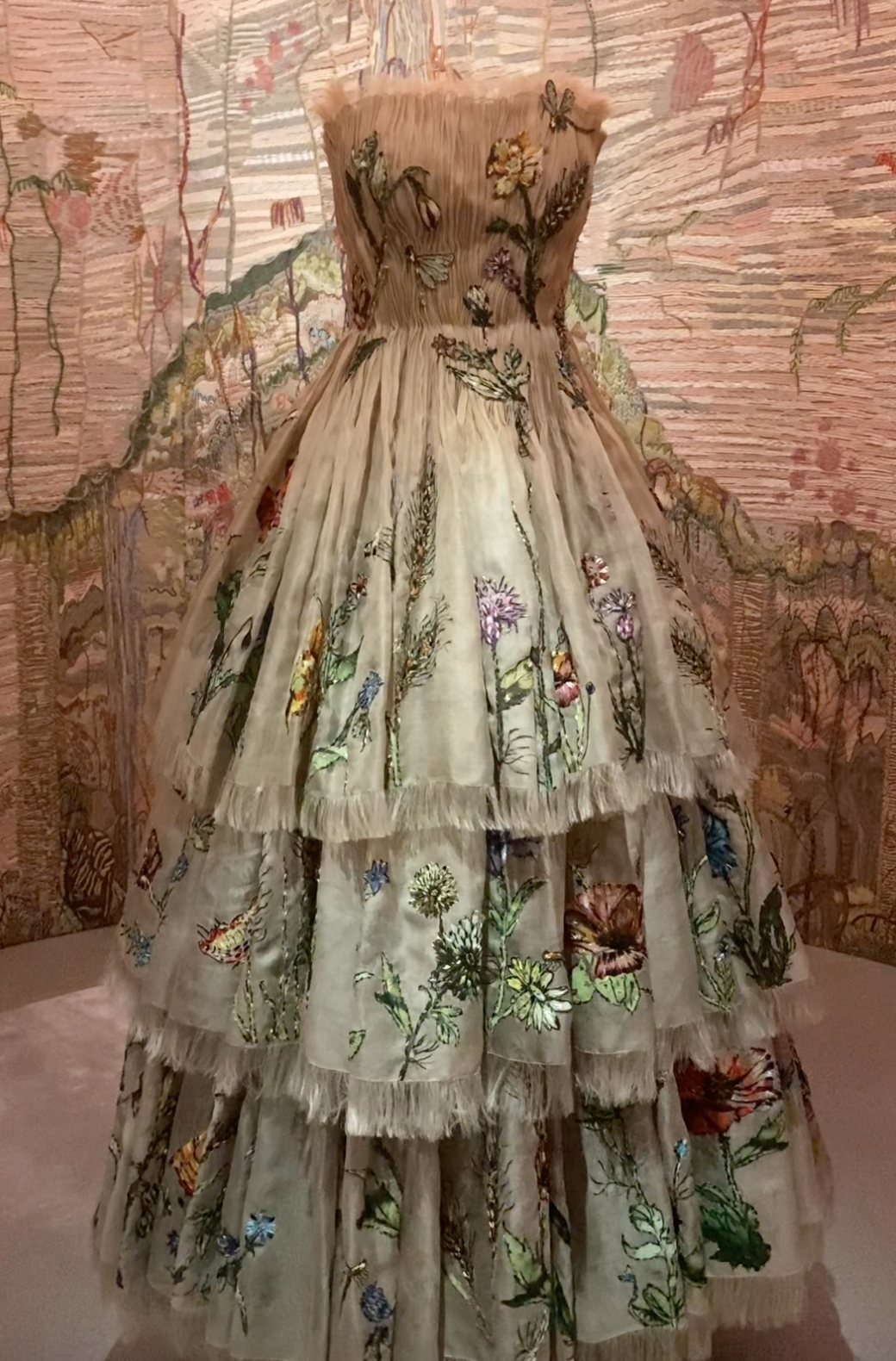
Embroidery at Galerie Dior in Paris (Source: Lottie Gibson)
Embroidery at Galerie Dior in Paris (Source: Lottie Gibson)
An embroidered dress at Galerie Dior in Paris (Source: Lottie Gibson)
An embroidered dress at Galerie Dior in Paris (Source: Lottie Gibson)
