
India
There are currently no digital-specific competition law rules in force in India. In March 2024, the Committee on Digital Competition Law published its report recommending the introduction of ex ante measures to regulate competition in the digital sector, along with a draft Digital Competition Bill. The proposed legislation contains rules similar to the provisions of the EU Digital Markets Act but also gives the Competition Commission of India the discretion to impose and enforce entity-specific conduct requirements similar to the proposed UK Digital Markets Consumer and Competition Bill. The proposed legislation is unlikely to come into effect before the end of 2024, and possibly even later.
Authored by Henry Mostyn, Riccardo Tremolada, Aleksandra Katolik & Mallika Sen
Updated as of September 2024
India
There are currently no digital-specific competition law rules in force in India. In March 2024, the Committee on Digital Competition Law published its report recommending the introduction of ex ante measures to regulate competition in the digital sector, along with a draft Digital Competition Bill. The proposed legislation contains rules similar to the provisions of the EU Digital Markets Act but also gives the Competition Commission of India the discretion to impose and enforce entity-specific conduct requirements similar to the proposed UK Digital Markets Consumer and Competition Bill. The proposed legislation is unlikely to come into effect before the end of 2024, and possibly even later.
Authored by Henry Mostyn, Riccardo Tremolada, Aleksandra Katolik & Mallika Sen
Updated as of September 2024
-
1. What rules govern competition in digital markets in India?

-
There are currently no digital-specific competition law rules in force in India. Digital firms are subject to general competition laws in the Competition Act, 2002 (No. 12 of 2003), as amended by the Competition (Amendment) Act, 2023.1
-
2. What is the status of any forthcoming digital regulation in India?
-
In 2022, the Indian Parliamentary Standing Committee on Finance gathered views and evidence from the Competition Commission of India (CCI), government institutions, representatives of industry associations, and technology companies, resulting in the publication of a report on “Anti-competitive Practices by Big Tech Companies” (2022 Report) in December 2022.2
The 2022 Report recommended that the Indian government should introduce a Digital Competition Act to “enhance” Indian competition law to “ensure a fair, transparent and contestable digital ecosystem”3 and establish a digital markets unit within the CCI to oversee the digital sector and provide recommendations to the government. The Digital Market and Data Unit has now been established by the CCI and is intended to be a “robust outfit staffed with skilled experts” to help the CCI monitor the activity of designated companies.4
In February 2023, the Indian government appointed a Committee on Digital Competition Law (CDCL) to assess whether the existing competition law framework is sufficient to address the challenges of the digital economy and whether there is a need for an ex ante regulation.5 The CDCL published its report in March 2024 (2024 Report) which includes a draft Digital Competition Bill (Draft DCB).6 Similarly to the EU Digital Markets Act (DMA), the Draft DCB proposes that digital companies would be designated based on quantitative and qualitative thresholds and subject to ex ante rules. 7 In addition, the Draft DCB gives the CCI discretion to design and enforce company-specific conduct rules, similarly to the UK Digital Markets, Consumers and Competition Bill.
The 2024 Report also recommends that the CCI expand its Digital Markets and Data Unit and suggests instituting a separate bench within the National Company Law Appellate Tribunal to deal with appeals against CCI orders, particularly those arising under the Draft DCB.
-
3. How are the proposed regulations expected to be enforced?
-
The 2024 Report proposes a designation and compliance reporting mechanism similar to that of the DMA.
- Designation. The 2024 Report suggests that the new digital regulations should apply to those entities that “have a significant presence and […] the ability to influence the Indian digital market,” defined as “Systemically Significant Digital Enterprises” (SSDEs).8 SSDEs must offer a Core Digital Service (CDS) in India to be within the scope of the Draft DCB. SSDEs would be designated on the basis of factors such as revenues, market capitalization, and number of active business and end users.9
- Compliance. Under the Draft DCB, SSDEs will have to report to the CCI on the measures taken to comply with the obligations set out in the bill.10 The Draft DCB does not currently specify the form or frequency of compliance reporting.
-
4. Which firms would the Draft DCB apply to?
-
The Draft DCB would apply to SSDEs that operate at least one CDS in India. CDSs are defined based on a broad list of services similar to the DMA: online search engines, online social networking services, video-sharing platform services, interpersonal communications services, operating systems, web browsers, cloud services, advertising services, and online intermediation services.11 Note that although the list is similar to the DMA, some CDS definitions are different and the list does not include virtual assistants.

If an enterprise operates a CDS in India, it will be deemed to be an SSDE if it meets the following cumulative criteria in each of the last three financial years:12
- Financial threshold. The enterprise must have (i) annual turnover in India of at least INR 4,000 crore (ca. USD 480 million); or (ii) annual global turnover of at least USD 30 billion; or (iii) gross merchandise value of at least INR 16,000 crore (ca. USD 1.9 billion); or (iv) global market capitalization or equivalent fair value of at least USD 75 billion.
- End users and business users thresholds. The CDS must have at least one crore (10 million) end users or (note: not “and”, which deviates from the EU’s DMA) 10,000 business users.
Even if these quantitative thresholds are not met, the CCI can designate an enterprise as an SSDEs based on qualitative criteria if it considers that the enterprise has a “significant presence” in respect of a CDS in India. The qualitative factors the CCI may take into account include the volume of commerce of the enterprise, the size and resources of the enterprise, network effects and data driven advantages, and market structure and size (among other factors).13
-
5. What are the main proposed substantive rules that govern the firms covered by Draft DCB?
-
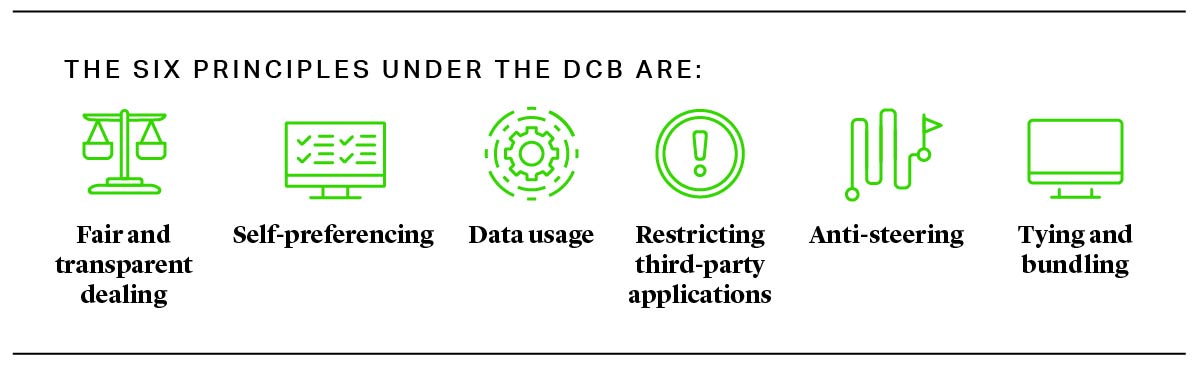
The Draft DCB sets out six principles with which SSDEs must comply. These principles would be supplemented by conduct requirements designed by the CCI and tailored to each SSDE. In other words, the six principles do not impose self-executing obligations on SSDEs; those obligations will come into effect only when the CCI identifies SSDE-specific conduct requirements.
The six principles are:
- Fair and transparent dealing.14 Requirement to operate in a fair, non-discriminatory and transparent manner with end users and business users. This is similar to the obligation under Art. 6(12) of the DMA, but is broader in scope.
- Self-preferencing.15 Prohibition on SSDEs self preferencing their own products and services, those of related parties or business partners. This is similar to the obligation under Art. 6(5) of the DMA, but is broader in scope.
- Data usage.16 This principle contains three obligations: (i) a prohibition on using non-public data of business users to compete with them; (ii) a prohibition on intermixing or cross-using personal data of end users or business users collected from different services, or allowing third parties to do this without users’ consent; and (iii) the requirement to allow business and end users easily port their data. This principle is similar to the combined obligations under Arts. 5(2), 6(2), 6(9) and 6(10) of the DMA.
- Restricting third-party applications.17 Requirement to enable sideloading of “third-party applications or other software,” and also enable users to choose and switch defaults. This provision is similar to the combined obligations under Arts. 6(3) and 6(4) of the DMA.
- Anti-steering.18 Requirement to allow business users to communicate external offers to their end users, and to direct their end users to their own or third-party services. This is similar to the obligation under Art. 5(4) of the DMA
- Tying and bundling.19 Prohibition of tying and bundling of SSDE’s own products and services with other products and services offered by the SSDE, related parties, third parties. This is similar to the combined obligations under two separate DMA provisions – Arts. 5(7) and 5(8) – but is broader in scope and seems to include a general prohibition on tying and bundling often governed by antitrust law.
-
6. Are there specific rules governing digital platforms’ relationships with publishers in India?
-
The Draft DCB does not contain specific rules relating to SSDEs’ relationships with publishers, although the CCI could use its discretion to govern these relationships through SSDE-specific conduct requirements.
The 2024 Report refers to the Information Technology (Intermediary Guidelines and Digital Media Ethics Code) Rules, 2021 and the Information Technology (Reasonable security practices and procedures and sensitive personal data or information) Rules, 2011 as part of its overview of the digital landscape in India. These rules regulate (among other things) news aggregators, publishers of news and current affairs content and online curated content.20
-
7. Will the CCI need to establish the effects of certain conduct in order to establish a breach of the rules?
-
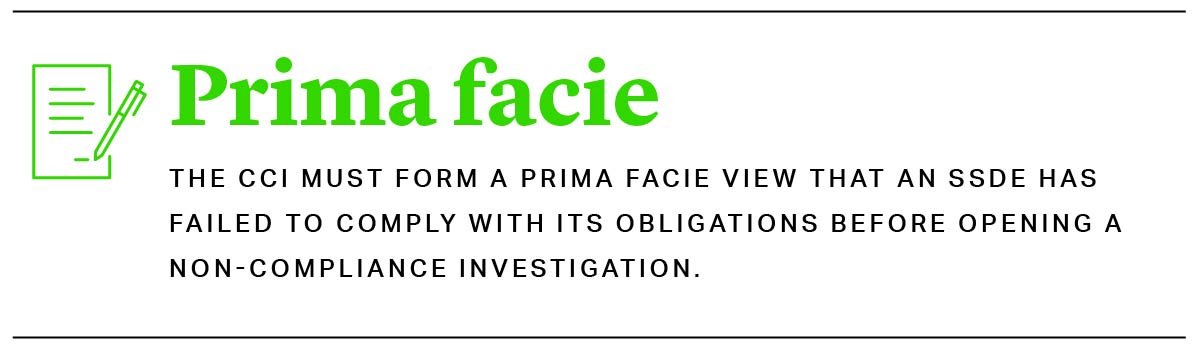
The Draft DCB does not suggest that anticompetitive effects will need to be established. The CCI can open a non-compliance investigation if it forms a prima facie view that an SSDE has failed to comply with its obligations.21 The investigative arm of the CCI – the Director General (DG) – would then carry out the non-compliance investigation and assess whether the conduct requirement has been breached or not. Similar to the DMA, there is no overarching requirement to show (even a potential or likely) adverse effect on competition in order to find a violation.
-
8. Can firms defend or objectively justify their conduct under the Report’s proposals?
-
The 2024 Report and the Draft DCB do not contain any overarching provisions that allow for objective justifications or defences. When the CCI formulates conduct requirements, however, it may include in the scope of the specific rules to justify conduct based on consumer or business benefits.
-
9. What procedural safeguards does the Draft DCB propose?
-
Once enacted, the Draft DCB would be enforced by the CCI who will have the power to regulate its own procedure but “shall be guided by the principles of natural justice, and subject to the other provisions of this Act and any rules made by the Central Government.”22
The procedure of a non-compliance investigations is similar to the procedure under the Competition Act, 2002. The CCI may direct the DG to carry out a non-compliance investigation if the CCI is of the view that there is a prima facie case.23
Parties may appeal the CCI’s decisions to the National Company Law Appellate Tribunal.24
-
10. What kinds of penalties or remedies can be imposed following a breach of the rules under the Draft DCB?
-
Under the Draft DCB, the CCI can impose penalties ranging from 1% of the global turnover of the enterprise (e.g., for the provision of incorrect or misleading information) to 10% of the global turnover of the enterprise (for failure to comply with substantive obligations under the Draft DCB).25
1%FIRMS IN BREACH OF THEIR OBLIGATIONS UNDER THE DRAFT DCB CAN FACE PENALTIES RANGING FROM 1% TO UP TO 10% OF THEIR GLOBAL TURNOVER. -
11. Has the CCI issued any guidance or reports regarding the digital regulation?
-
Before the publication of the 2022 Report (and its preceding consultation), the CCI carried out a market study on e-commerce in India and published its findings and observations in January 2020.26 Following the publication of the 2024 Report, the Ministry of Corporate Affairs opened a public consultation on the report and the Draft DCB, which closed on 15 May 2024.
-
12. Is the new regime competition based, or does it target other types of conduct, such as consumer protection, moderation of content, or privacy?
-
The proposed regime is competition based. The overarching framework of the Draft DCB is inspired by the DMA and the UK’s Digital Markets, Consumers and Competition Bill. While the 2024 Report touches on issues relating to data usage, it does not address other issues relevant to digital platforms such as content moderation.
-
13. What is the current enforcement practice with respect to conduct that is expected to be addressed by the digital regulation?
-
The CCI has been active in its use of existing enforcement tools against digital platforms. Some recent CCI investigations include:
- Google Android decision (October 2022). Following an investigation, the CCI fined Google for alleged anti-competitive practices in relation to Android mobile devices.27 The CCI decision is currently under appeal.
- Google Play Store decision (October 2022). Following an investigation, the CCI fined Google for alleged anti-competitive practices in relation to its Play Store policies.28 The CCI decision is currently under appeal.
- Swiggy / Zomato investigation (April 2022). In 2022, the CCI launched an investigation into alleged anti-competitive practices by Swiggy and Zomato (food delivery companies), including bundling, lack of transparency towards restaurants, and high commissions.29
- Apple App Store billing investigation (December 2021). The CCI launched an investigation into Apple’s App Store practices relating to high fees and the lack of third-party payment options on the App Store.30
- Amazon / Flipkart investigation (January 2020). In 2020, the CCI launched an investigation against Amazon and Flipkart (the country’s two largest marketplaces) relating to allegations of deep discounting, preferential listings and exclusivity.31
-
14. Are there merger rules specific to digital platforms in India?
-
No. The 2024 Report notes that it was not necessary to include provisions relating to mergers in the Draft DCB in light of the recent amendments to the Competition Act in relation to merger control.32
Contacts
Henry Mostyn
Partner
Riccardo Tremolada
Associate
Aleksandra Katolik
Associate
Browse Jurisdictions
