
Kyori Sokin, Remittances to Hometowns in Japan from Yokohama Specie Bank
Introduction
Among the most valuable records of the Yokohama Specie Bank included in the Seizo-Oka collection, JAHA, are the original forms of kyori sokin 郷里送金, remittances to hometowns. These remittance forms from the Yokohama Specie Bank, Los Angeles subbranch, are from 1938 and 1939. Although the available documents are partial and cover only a few months from one subbranch, more than 2,200 hand-written forms tell us a lot about the prewar Issei family networks and their social and economic connections to their hometowns in Japan and beyond. Who sent money to whom and to where in Japan? How much money was sent? Why were these remittances sent to Japan?
YSB remittance forms show how broadly Issei networks spread all over Japan and beyond through their family ties. Their monetary support reflects how much the Issei cared about their families and friends in their hometowns in a challenging period when all people in Japan were forced to be involved in the war against China and, later, the US.
YSB, Los Angeles Subbranch Advertisement from Rafu Shimpo, August 24, 1938. Hoji Shinbun Digital Collection, Hoover Archives
YSB, Los Angeles Subbranch Advertisement from Rafu Shimpo, August 24, 1938. Hoji Shinbun Digital Collection, Hoover Archives
Historical Background
Throughout the 1930s, Issei in California were keenly aware of the rising militarism in their home country. Japan invaded Manchuria in 1931, and the Marco Polo Bridge Incident in July 1937 led to the Second Sino-Japanese War. Many Issei regarded sending donations to support imperial Japan’s war effort as a “national duty” of Japanese citizens. One must remember that Issei were not eligible to become U.S. citizens at that time because they were not “white” race.
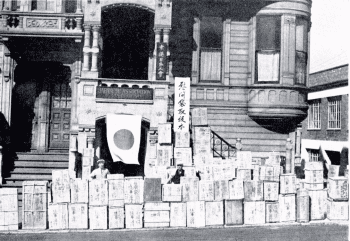
After the 1937 Marco Polo Bridge Incident, Japanese communities on the West Coast launched massive patriotic campaigns to collect and send money called “comfort money” imon kin 慰問金 and care packages called “comfort bags” imon bukuro 慰問袋 to Japanese soldiers in Manchuria. Japanese community groups competed against each other to see who could raise the most donations and thereby to show their loyalty to Japan as well as their superior position in the Japanese American community. Japanese community papers helped stir the competition by praising donors for the considerable sums of money they raised.
"Southern California Tops Patriotic Donations." Kashu Mainichi, February 3, 1939. Hoji Shinbun Digital Collection. Hoover Archives
"Southern California Tops Patriotic Donations." Kashu Mainichi, February 3, 1939. Hoji Shinbun Digital Collection. Hoover Archives
Who sent money to Japan?
Individual remittance forms contain a treasure trove of information showing the trans-Pacific networks of Issei in the prewar period. All remittance forms were handwritten by Issei remitters or bank officers and included their names, U.S. addresses, the names of recipients, their addresses in Japan, and the amount of money being remitted in U.S. dollars and Japanese yen. Although there was no description of the purposes or reasons for the remittances on the form, we can guess why Issei sent money to Japan from memos left in the margins and by researching the personal information of the remitters and recipients.
Customers could remit money from convenient locations, such as the Goshado Bookstore shown above, rather than going to a Yokohama Specie Bank office. JAHA Collection.
Customers could remit money from convenient locations, such as the Goshado Bookstore shown above, rather than going to a Yokohama Specie Bank office. JAHA Collection.
Yokohama Specie Bank Branch's Remittance Agencies. YSB Records, JAHA Collection.
Yokohama Specie Bank Branch's Remittance Agencies. YSB Records, JAHA Collection.
Explore a remittance form to learn how we collected historical information.
Remitter
Name
in Japanese Katayama Teruo
肩山 輝夫
in English
T. Katayama
Recipient's Name
Katayama Sakotaro
肩山 佐古太郎
Recipient's Address
Fusetsuki, Seno village, Aki County, Hiroshima
広島県安藝郡瀬野村伏附
Remitter's Address and Phone Number
Suzuki, Yamamoto (YSB bankers' signature stamps)
U.S. dollar 28.95 @ 28.95 (exchange rate) The amount of remittance for Japanese yen 100.00 yen
A remittance form can reveal intimate relationships between Japanese Americans and their homeland.
There are 753 remittance forms from the Yokohama Specie Bank, Los Angeles subbranch, from August 1938 in the YSB Collection. Of those 753 remittances, 721 (95.7%) were from residents living in California, mostly Greater Los Angeles, from urban areas to farming communities. Japanese living in nearby states like Arizona and Texas also sent money to Japan via the LA subbranch (seven from Arizona and two from Texas). Moreover, Issei living in Mexico (21 cases) also sent vast amounts of money via the LA subbranch to Japan, with an average of about twice that of California. The last names of remitters match with those of recipients in about half of all the remittances, meaning most Issei sent money to their families in Japan.
Explore the interactive map below to discover who sent money from the United States to Japan.
The Total Amount and Number of Remittance Cases by State or Area for Remitters from the YSB, LA Subbranch in August 1938
The Total Amount and Number of Remittance Cases by State or Area for Remitters from the YSB, LA Subbranch in August 1938
Many Japanese Americans were farmers who earned their living and saved money for their families in both the United States and Japan. A scene from the Los Angeles Produce Market in 1909.
Japanese Americans continued to work on farms and thrived in Southern California. A scene from the Los Angeles Produce Market in the 1930s.
How much money?
The total amount of remittances from the LA subbranch in August 1938 was about $27,000, equivalent to 93,400 Japanese yen. This had considerable value for the recipients living in Japan at that time. For example, given that the starting salary for Japanese government officers in Japan was seventy-five yen (22 U.S. dollars) per month in 1937, which is about 200,000 yen (1,330 U.S. dollars) in 2023, the total amount of remittances from the LA subbranch in August 1938 alone is equivalent to over two hundred million yen (1.3 million U.S. dollars) today. When calculated annually, the amount of money from the remittances in 1938 made up one-quarter of the tax revenue of Wakayama prefecture, the home prefecture of the largest population of Japanese immigrants in Southern California in the 1930s.
Explore the map below to see which regions received the most money. For instance, the coastal-hugging distribution of recipients in Wakayama Prefecture highlights the areas where Japanese Americans originally came from.
Collective Efforts
Not all Issei sent large sums of money to Japan. The amount of money remitted ranged from very small, such as $1.40, to huge, like $900.00. Some of the large remittances were the product of collective efforts. One example was when Issei from Koshi village 合志村, Kumamoto, remitted over $150 to the Koshi village chief as “comfort money for families whose member went to the war front” 出征軍人遺家族慰問金.
Remittance Application for Sending Money to Servicemen in the Home Village. YSB Records, JAHA Collection
Remittance Application for Sending Money to Servicemen in the Home Village. YSB Records, JAHA Collection
It is well known that Japanese immigrants in the U.S. mostly came from western Japan, such as Hiroshima, Fukuoka, Kumamoto, and Wakayama. Nevertheless, the money was remitted to almost all prefectures in Japan, which shows the width and diversity of the Issei’s trans-local networks between Los Angeles and Japan. Simply put, the Issei did not solely remit money to their hometowns, even though the forms were entitled “remittances to hometowns.”
Wakayama received the largest sum of money ($2,940/10,000 yen) with 72 remittances sent, which seems natural since the Wakayama Prefectural Association (kenjinkai) was one of the largest in Southern California at that time. Following Wakayama, the second largest amount of money went to Hiroshima ($2,600/9,000 yen), with 72, whose number of kenjinkai was also big. Other prefectures in western Japan, such as Fukuoka and Kagoshima, followed.
Why?
People sent money to Japan for many reasons, from paying for magazine subscriptions and supporting children studying in Japan to contributing donations for servicemen in their home villages. The remittance records of the Yokohama Specie Bank reveal an even broader story: its customers were not only Japanese Americans but also Koreans and Taiwanese. Their presence reflects the far-reaching financial networks of Japan’s colonial era and the diverse communities linked through these flows of money. The YSB remittance slips in the JAHA Collection allow us to look closely at individual cases and trace the histories that unfolded across the Pacific.
Shufu no tomo. Buddhist Church of San Francisco Collection. Hoover Archives
Shufu no tomo. Buddhist Church of San Francisco Collection. Hoover Archives
Remittances to Businesses in Tokyo
Tokyo was the destination for the greatest number of remittances (92), but the total sum of money it received was $2,093, behind Wakayama and Hiroshima. The reason is that about one-third (37) of the remittances to Tokyo went to businesses and organizations; 23 went to publishers such as Shufu no Tomo 主婦の友社, a publisher of ladies' magazines, and Kodansha 大日本雄辯會講談社, and were probably subscription fees for Japanese magazines. Others seemed to be donations to religious organizations, “comfort money” for the Japanese military, and payments to insurance companies and other businesses.
Remittance Application for Payment of Magazine Subscription Fees. YSB Records, JAHA Collection.
Remittance Application for Payment of Magazine Subscription Fees. YSB Records, JAHA Collection.
Patriotic Planes. Photographs from the Dennis M. Ogawa Nippu Jiji Collection. Collection. Hoover Archives
Patriotic Planes. Photographs from the Dennis M. Ogawa Nippu Jiji Collection. Collection. Hoover Archives
Comfort Money for the Japanese Military
While many competing Japanese American organizations often boasted in local Japanese newspapers about the enormous amounts of their donations, there were also some very modest Issei who did not wish to boast. One Issei man, for example, who remitted 100 yen each to the Relief Departments of the Japanese Army and Navy, left a note for a bank officer, saying, “Please do not publish my donation in the newspaper.”
Remittance Application for Sending Money to the Relief Departments of the Japanese Army and Navy. YSB Records, JAHA Collection
Remittance Application for Sending Money to the Relief Departments of the Japanese Army and Navy. YSB Records, JAHA Collection
Kongosan Chosen (Korea) ca. 1920-1930. Poster Collection, Hoover Archives
Kongosan Chosen (Korea) ca. 1920-1930. Poster Collection, Hoover Archives
Remittances to Colonial Korea and Taiwan
Issei also remitted money to Korea, Taiwan, and the Shanghai International Settlement where their families were transplanted. The remittance records demonstrate that Issei in California were connected not only to their hometowns in Japan but also through family networks to Japanese colonies in East Asia. YSB records show that Korean residents living in the US also used the YSB LA subbranch to remit money to their Korean families or businesses in Korea under Japanese rule, though the number of such cases is small. Song, a Korean living in Los Angeles, regularly sent money to someone who seemed to be his family in colonial Korea.
Remittance Application to Send Money to Korea. YSB Records, JAHA Collection
Remittance Application to Send Money to Korea. YSB Records, JAHA Collection
Asama Maru, September 23, 1938. Dennis M. Ogawa Nippu Jiji Photograph Collection. Hoover Archives.
Asama Maru, September 23, 1938. Dennis M. Ogawa Nippu Jiji Photograph Collection. Hoover Archives.
From Issei Parents to Nisei Studying in Japan
There surely were many cases of remittances sent from Issei parents to their young Nisei children staying in Japan. In the mid-1930s, about four thousand young Nisei resided in large cities in Japan, such as Tokyo and Osaka, to study in high schools or universities. For example, the YSB Collection includes a remittance form from an Issei parent to a Nisei son studying at Aoyama Gakuin High School. Many Issei parents sent Nisei children to Japan for higher education because it was much cheaper than going to universities in the U.S. due to the higher value of the U.S. dollar to the Japanese yen. Since Nisei, with higher education, struggled to find decent jobs in the U.S, studying in Japan was a promising opportunity for them to seek better employment in their ancestral country.
We can find such an example in the YSB remittance forms. Kikuyo Izumida 泉田 キクヨ in Gardena sent $75 to her son Tsutomu (or Ben) 勉, who was studying at Tokyo University of Commerce 東京商科大學, (current Hitotsubashi University). Tsutomu Izumida was called a genius in Japanese communities in LA; he studied at Compton Gakuen, a Japanese language school in Los Angeles, and then went to Japan to receive his higher education. After graduating cum laude from Kanto Gakuin High School of Business 関東学院高等商業部 in 1934, he turned down a job offer from a trading company. He chose, instead, to study at the Tokyo University of Commerce. Izumida was hired by Nippon Yusen Kaisha (NYK) after graduation and became an officer of the Asama Maru, known as the fastest trans-Pacific Ocean liner between Japan and the US West Coast.
Remittance Application to Send Money to a Son Studying in Japan. YSB Records, JAHA Collection
Remittance Application to Send Money to a Son Studying in Japan. YSB Records, JAHA Collection
Takeo Miki, Prime Minister of Japan, 1974. Prime Minister's Office. https://www.kantei.go.jp/jp/terms.html
Takeo Miki, Prime Minister of Japan, 1974. Prime Minister's Office. https://www.kantei.go.jp/jp/terms.html
A Connection to Former Prime Minister Takeo Miki
Some remittances were addressed to the residences of guardians where young Nisei stayed. Tameichi Asano 麻野 為一, an Issei from Nagano who operated a hotel in Los Angeles, remitted money to his Nisei son, Mikio 幹夫, staying in the residence of Takeo Miki 三木武夫, a politician who kept close ties with the Japanese American community on the West Coast through his study in the US in the early 1930s. After going back to Japan, Miki was elected to the House of Representatives from Tokushima in 1937. He continued his political career until his death in 1988, including serving as the prime minister from 1974 to 1976. In the late 1930s, young Miki often took care of young Nisei in his residence who were visiting or studying in Japan. He later openly opposed Japan’s war against the United States. Mikio Asano studied at Kyoto Imperial University and spent the wartime in Japan while his father was arrested by the FBI and sent to the DOJ camps.
Remittance Application to Send Money to Takeo Miki. YSB Records, JAHA Collection
Remittance Application to Send Money to Takeo Miki. YSB Records, JAHA Collection
Acknowledgment
I would like to thank the students who took my American History course at Seijo University in 2022—especially Chihiro Saito, Kazuki Watanabe, and Daisuke Saito—for their assistance with data entry. I am also grateful to Shinya Yoshida, Yuukichi Niwayama, and Ayuko Takeda for their timely help.
