
Halcyon's New Day:
How a Boulder School Transforms the Mental Health of its Troubled Students
Matt Dudek was immersed in a meeting when the radio he wears pinned to his side crackled to life.
“Matt, we need you in the south,” a voice said.
As principal of a school for students with emotional and discipline problems, Dudek knows these are the moments that test him to his fullest. While the call could mean a number of things, most likely it’s a sign that a student is in crisis.
Dudek steps out of the meeting and heads toward the school’s south wing with his key card in hand. As he approaches, he hears the faint muffle of a student shouting from outside the heavy metal door. He scans his card and enters the hallway. He sees her now. Her fists are clenched.
“I’m going to swing on that bitch,” she said, looking at a teacher.
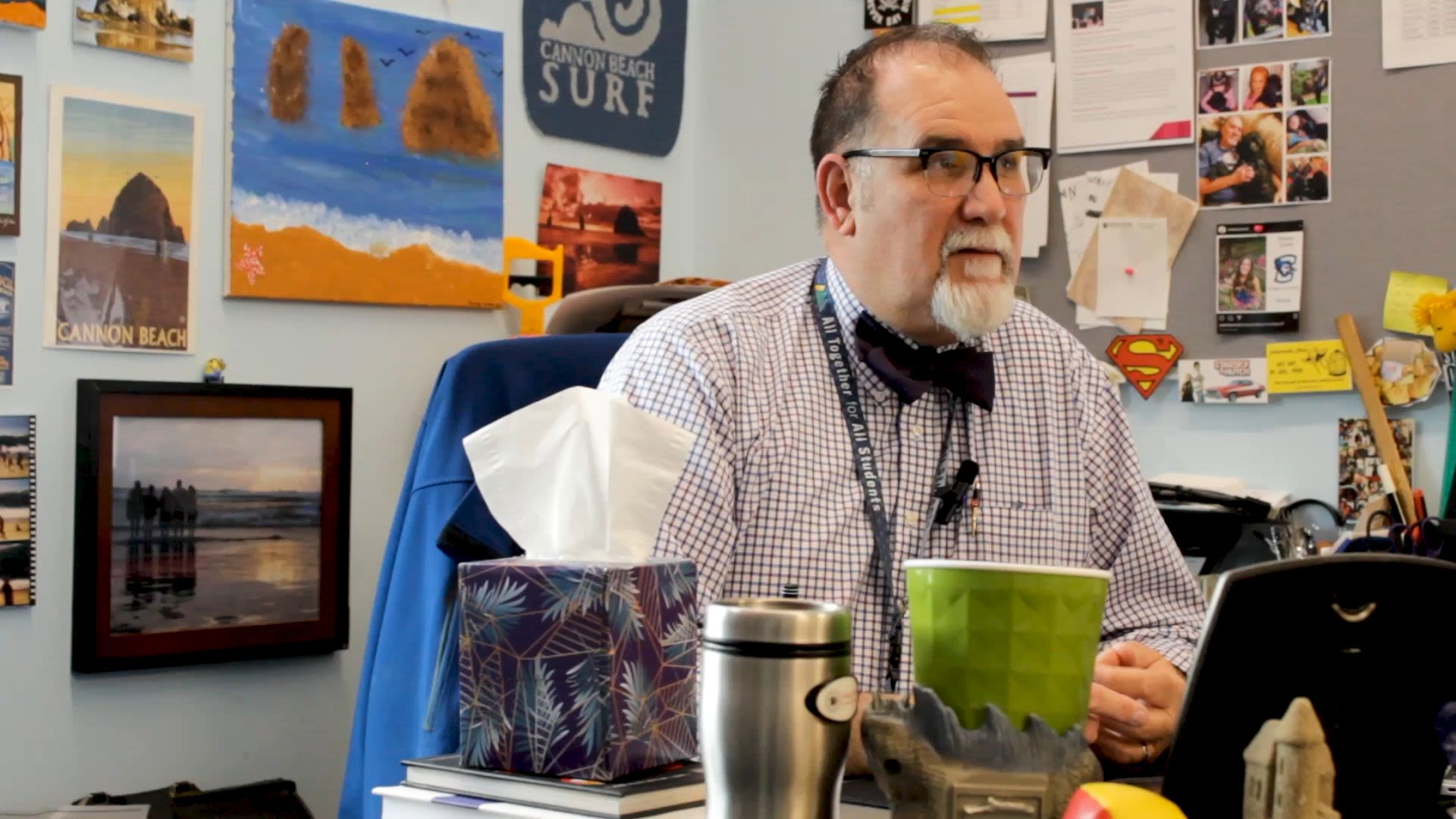
With more than 30 years of experience in special education, Dudek is proud to have spent the last 15 as the principal of Halcyon, a school dedicated to serving some of the most troubled students in the Boulder Valley School District.
“There are days when you come out to Halcyon and you think, ‘Oh, what a cute little private school. Students are learning, teachers are teaching, birds are chirping.' … And then there are days when you come out, and you're like, ‘Oh my Lord, this is what it must be like in an intensive psychiatric setting,’” Dudek said.
Dudek, who likes to say one of his most tragic flaws is his commitment to finding the positive in every situation, uses these moments to learn his students better.
“It's not simply ‘Let's get through the crisis and then calm you down and go on your way,’” he explained. Instead they ask questions like: “‘What led to that? How were you feeling? How can we do things differently next time?’”
And this is where Halcyon’s success lies. In many ways, the school represents the changes to the field of special education.
“Over the years it's kind of gone from just kind of maintaining students to really a push for growth,” said Travis Dorocher, the district’s director of special education.
As the most restrictive school in the district, students with disabilities must be referred to Halcyon by their home school after significant evaluation. This decision is not taken lightly, since students at Halcyon are stripped of certain freedoms, but a necessity in cases where a student poses harm to themselves or others.
In other cases, Halcyon is considered a step down from programs with providing 24-hour behavioral care. Students coming from more intensive programs outside the district, such as residential school or even juvenile hall, are required to attend Halcyon before returning to a traditional school.
Halcyon’s staff seek to transfer students back to their home school by providing them with the tools necessary to strengthen their mental health to the degree they can be successful in school, at home and within their community.
On average, students stay at Halcyon for three to six months before returning to a traditional school. During that time, students have access to on-site therapists, a psychiatric nurse and work with teachers that focus on special education.
Students at Halcyon follow plans created for them by specialists and require that teachers come from the field of special education. But many of the students aren't dealing with intellectual disabilities normally associated with special education. Rather, the plans seek to address serious emotional disabilities or disturbances that prevent them from benefiting from traditional classroom environments.
At Halcyon, it’s not a matter of curing kids of their disabilities. It’s about helping them find better ways to cope so they can reach their full potential.
“We don't fix kids here,” Dudek said. “We just try to give them some different tools from the mental health side of things.”
Their struggles include several different mental challenges, such as anxiety disorders, bipolar disorder, conduct disorder, depression and schizophrenia. While the causes vary, some include brain disorders, hereditary stress, trauma and significant stress at home.
In that way, special education has taken on new meaning. Particularly in light of new findings from the CDC in 2021, which revealed 42% of high school students in the U.S. reporting symptoms of depression that has stopped them from doing their usual activities. A little more than half said they’d seriously considered suicide.
For several years, suicide has been the leading cause of death in Colorado for children age 10 and older. Furthermore, in April 2021 the Colorado Sun reported that mental health emergency visits were up 90% compared with April 2019.
The pandemic has certainly played into this, according to Dudek. And to make matters worse, as mental health needs skyrocket, the amount of services available for kids continues to plummet.
To meet that need, Boulder Valley offers several programs for students who are struggling. The Intensive Learning Center for Students with Affective Needs, also known as the ICAN Program, is the first step for students whose behavioral or emotional needs interfere with their ability to learn.
The intensive learning program provides students in need with additional resources that allow them to continue their education in the traditional school setting. However, it is sometimes the case that a student may need a more extensive approach.
That is where Halcyon School comes in.
The sun beams down on a stop sign outside Halcyon on April 12, 2023, in Boulder, Colo. (Gabrielle Gomez, CU News Corps)
The sun beams down on a stop sign outside Halcyon on April 12, 2023, in Boulder, Colo. (Gabrielle Gomez, CU News Corps)
Nestled on the corner of 31st and Bucknell Court is home to the small but mighty Panther Nation, also known as Halcyon. Currently, Halcyon has 19 students, but what it lacks in size is made up for in its crystal clear view of the Flatirons and its tight knit community. “Because we are so small, we're able to form really deep relationships with the students,” said Elise Lauerman, Halcyon’s Language Arts teacher.
Using the same curriculum as other Boulder Valley schools, teachers at Halcyon work to give the students the closest experience to what traditional schools offer. But even that can be a hard sell. For example, an expectation in traditional classrooms is that students take standardized tests. But some Halcyon students were recently complaining about that requirement.
For Dudek, the controversy was a teachable moment. “There was a time in special education when testing was difficult to access, so now students are like, ‘Will you stop advocating for us? I don't want to take those tests,’” Dudek said. “And I'm like, ‘No, you get to, just like any other student.’”
Despite its similarities to a traditional school, Halcyon operates differently in some key aspects.
Since students K-12 are referred to Halcyon on a case by case basis, there aren't enough students to teach by grade level. Instead, there is a teacher for each subject that works with a group of elementary, middle and high school students at different points in the day.
Rosie Apke Kinder, who started Halcyon sophomore year, felt like this structure created disparities in the classroom. “I was learning things I already knew, which was hard,” she said.
Rosie Apke Kinder, a former Halcyon student, poses in front of the school's outdoor shed on April 12, 2023 in Boulder, Colo. (Gabrielle Gomez, CU News Corps)
Rosie Apke Kinder, a former Halcyon student, poses in front of the school's outdoor shed on April 12, 2023 in Boulder, Colo. (Gabrielle Gomez, CU News Corps)
Soon after being diagnosed with an emotional disability in 2019, Rosie was taken to a residential program in Denver. “I was pretty angry back then because I didn't know I was going to a residential school,” she said. “So it kind of made me act up more.”
In the course of a year, Rosie attended three different residential schools before coming to Halcyon in January 2021. Although she was still working through emotional challenges, having to complete a special education program frustrated Rosie, who felt like she was missing out on a normal high school experience.
“All of the students here have a disability, so it's really just knowing who they are and what they need,” Lauerman said. For some that might be taking a break from work all together. “One of my higher performing students was having a harder mental health day, and so part of her plan is that she can just ask for space.”
Like many students at Halcyon, this student has a history of truancy. That day, nearly half the students were absent. In an effort to keep her in the building, Lauerman made a compromise by excusing the student from their assignment and allowing her to sit at the back of the classroom.
“We know when they're here, they're safe and they're accessing mental health support,” Lauerman said.
As for Rosie, she eventually was able to advocate for more challenging work and less restrictions, bringing her closer to her goal of attending Boulder Prep. By junior year, Rosie was allowed to split time between Halcyon and Fairview High School.
“If you go along with the program it's a lot more relaxed,” Rosie said.
Dudek and his staff start each day the same way: standing on the sidewalk as the buses pull in and giving a personal greeting to each student. “I want our students to see our smiling faces when they get off the buses so they know we're excited to see them and welcome them to school,” Dudek said.
At the same time, students drop off their belongings and the staff are able to get a sense of what students might be feeling that day.
As the most intensive school setting in the district, employees at Halcyon take extra precautionary measures to ensure things run as smoothly as possible. While their focus is to prepare students for the real world, things like cell phones, unstructured time and free roam of the campus have created challenges disruptive to the student experience as a whole.
This year, two students were deemed too unsafe to come to school after attempting to get a gun and to bring it to Halcyon. Right now, they are working on bringing one of those students back.
The typical behavior of a Halcyon student could fall within four overlapping categories, according to Dudek. Those impacted by trauma tend to act out and cause destruction, while others might exhibit signs of depression, anxiety and suicidal ideation. This behavior could also stem from other biological factors, such as varying degrees of autism or those who experience visual or auditory hallucinations.
“It's not uncommon to be verbally abused, to have stuff thrown at you, to have students threatening to kill you or even go after your car - those things happen, ” Dudek said. “And that's the reason that's why they're here.”
In order to ensure the safety of both students and staff members, the use of restraining methods is a common practice at places like Halcyon. Rosie, who has experience in residential programs, recalls that staff members frequently restrained students.
“I'd say probably like half of the kids got restrained pretty frequently and the other half got restrained at least once for sure,” she said.
However, the use of restraints can be traumatic for people in crisis. That's why the staff at Halcyon have decided to take a more sensitive approach. Rather than resorting to physical methods, Dudek tells the students that he would prefer to let them destroy the building.
To make this possible, Halcyon has additional classrooms and a higher staff-to-student ratio. If a student becomes disruptive or uncooperative, the rest of the class can move to a new classroom and continue learning while another staff member manages the situation.
Furthermore, if a student tries to leave campus, there are enough staff members available to follow them without using physical force.
While Dudek admits everyday is a challenge at Halcyon, crisis management feels “seemingly innocuous” compared to the vicarious trauma that comes from working with distressed kids. “It's really easy to get sucked into just how horrible some of these kids' lives have been,” Dudek said.
But he wouldn’t have it any other way. “I love it when kids say, ‘Oh, you're only here for the money.’” Dudek laughed. “No, we're here because we have a specific calling to work with this population.”
While the same is true for Halcyon’s staff, this hasn’t always been the case. Teacher retention continues to be a significant barrier in the emotionally demanding field of special education. A 2017 study from The Regional Educational Laboratory Central revealed that special education teachers were 72% more likely to switch schools than other teachers.
Lauerman has been at Halcyon for two years and admits she’s looked for other jobs in the past. “This is the hardest special-ed setting and students that I've ever worked with,” she said.
Employees working in Boulder Valley's intensive care programs are three times more likely to leave their jobs compared to those in general education. In fact, most intensive care program employees step down from their positions within three to five years, according to Durocher.
It's not only the difficulty of working with students who require the most assistance, but also concerns about potential legal consequences that push people out of the role. This is particularly evident among teachers in Boulder Valley, since their students often come from well-off families with high expectations and the ability to hire legal representation.
“You never think that you're going to be like testifying in court or being investigated by a state campaign officer,” Durocher said.
School psychologists are also in short supply, leaving kids without enough support at school. “I've had kids that are like, ‘Why would I talk to this therapist? Because the last four therapists I've had cycled in and cycled out,’” Dudek said.
The National Association of School Psychologists (NASP), recommends that each school should have at least one psychologist for every 500 students. Nevertheless, numerous schools are finding it challenging to fulfill this standard. At present, the data estimates an average ratio of one psychologist for every 1,211 students. In some states, this ratio is even higher, approaching one psychologist for every 5,000 students.
With two therapists and maximum capacity of 32 students, Halcyon kids certainly have beaten these odds. However, there are still significant staffing issues despite the district’s efforts to provide competitive wages for special education teachers.
For the last decade, the country has faced a significant shortage of special education teachers. Eighty-two percent of special educators from across the nation report that there are not enough professionals to meet the needs of students with disabilities, according to the National Coalition on Personnel Shortages in Special Education (SISP).
Halcyon is no exception. For the past year, it has struggled to fill a teaching aide position. But what it lacks in quantity, is made up in quality. “If there's any question about whether or not this community cares about our kids, walk around this building,” Dudek said.
Guests must go through two sets of automatic locking doors controlled by Halcyon's administration before entering the school's main entrance, a narrow room that feeds into "the heart" of Halcyon on April 12, 2023, in Boulder, Colo. (Gabrielle Gomez, CU News Corps)
Guests must go through two sets of automatic locking doors controlled by Halcyon's administration before entering the school's main entrance, a narrow room that feeds into "the heart" of Halcyon on April 12, 2023, in Boulder, Colo. (Gabrielle Gomez, CU News Corps)
Halcyon's lobby, also referred to as "the heart" of the building, separates the north and south wings of the school and provides access to two multipurpose rooms, a bathroom and Dudek's office on April 12, 2023, in Boulder, Colo. (Gabrielle Gomez, CU News Corps)
Halcyon's lobby, also referred to as "the heart" of the building, separates the north and south wings of the school and provides access to two multipurpose rooms, a bathroom and Dudek's office on April 12, 2023, in Boulder, Colo. (Gabrielle Gomez, CU News Corps)
As part of Halcyon's rebuild in 2017, each wing now has a "calm room" for students in crisis on April 10, 2023 in Boulder, Colo. (Gabrielle Gomez, CU News Corps)
As part of Halcyon's rebuild in 2017, each wing now has a "calm room" for students in crisis on April 10, 2023 in Boulder, Colo. (Gabrielle Gomez, CU News Corps)
Halcyon's "mega multipurpose room" is used as a cafeteria, fitness center, event space and is where daily conferencing is held to celebrate student successes and map changes for the following day on April 12, 2023 in Boulder, Colo. (Gabrielle Gomez, CU News Corps)
Halcyon's "mega multipurpose room" is used as a cafeteria, fitness center, event space and is where daily conferencing is held to celebrate student successes and map changes for the following day on April 12, 2023 in Boulder, Colo. (Gabrielle Gomez, CU News Corps)
Rosie Apke Kinder, who attended Halcyon School for nearly two years, talks with her former teacher, Elise Lauerman, while visiting the campus on April 12, 2023.
Rosie Apke Kinder, who attended Halcyon School for nearly two years, talks with her former teacher, Elise Lauerman, while visiting the campus on April 12, 2023.
The sun shines on Halcyon's playground and there is a clear view of Boulder's Flatirons in the background on April 10, 2023. (Gabrielle Gomez, CU News Corps)
The sun shines on Halcyon's playground and there is a clear view of Boulder's Flatirons in the background on April 10, 2023. (Gabrielle Gomez, CU News Corps)
Thanks to the school board, district superintendent's office, community and bond oversight committee, Halcyon received a multi-million dollar makeover in 2017. And they couldn’t be more grateful, Dudek added while stretching out his arms in Halcyon’s main lobby, “In the old building, I could touch the hallways with my elbows and in my head hit the ceiling.”
The new space, according to Dudek, is built with a trauma informed lens. The main entrance features three sets of heavy, automatic locking doors with a buzzer system for added security. Inside the sunlit lobby, known as "the heart" of Halcyon, there are entrances to the north and south wings of the school.
Each wing comprises several classrooms, a calm room, and private break rooms for staff, equipped with automatic locks that are accessible via key cards. This design aims to minimize disruptions during student crises.
Despite this, it's important to note that the constant state of chaos also takes a toll on the students.
“A lot of kids are struggling and they act out a lot. It's hard to deal with,” Rosie said.
While community is a core value at Halcyon, most days students are advised to keep to themselves. Unlike a traditional school, the cafeteria only has enough seating for a few students at a time and is also used as a fitness center, event space and where daily conferencing is held to celebrate student successes and map changes for the following day.
For Rosie, daily conferencing is what kept her on track to leave Halcyon early.
Instead of everyone having lunch at the same time, it’s broken up into 15 minute intervals where small groups of students filter through and no touching is allowed. As Dudek puts it, “Unstructured time is not usually a positive for many kids.”
Friday’s, however, are a different story. At the end of each week Halcyon hosts “Friday Funday,” where the community gathers for different activities like building old arcade games, cornhole tournaments or bingo.
“A lot of our kids don't get some of those traditional kinds of kid experiences,” Dudek said. “So we try to inject fun into things.”
Another fan-favorite tradition at Halcyon is “First Friday,” where a staff member volunteers to cook a special breakfast for the entire school on the first Friday of each month. The enthusiasm the students display for this occasion is so intense that it evokes mixed emotions of joy and sadness in Dudek.
“On the one hand, it makes me happy,” Dudek said. “But sometimes it makes me sad that something as seemingly trivial as just breakfast is so meaningful.”
For students like Rosie breakfast is not just a meal to tide them over until lunch, but an act of compassion that provides them with the strength and resilience to keep going.
Rosie will be graduating from Boulder Prep this May and plans to attend CU Denver to study criminal justice in the fall.
