10 years of growth
We welcomed our first students in 2012.
Ten years on, we look back at some key moments in our growth since then.
2012-13
Autumn 2012
We begin teaching and researching out of Merton Street with 38 students from 19 countries.
Class of 2012
Class of 2012
2013-14
September 2013
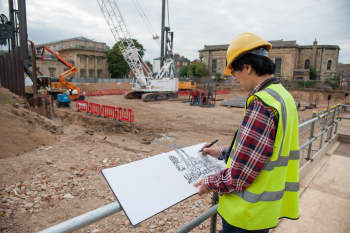
As our activities continue from Merton Street, work begins to construct the School’s new home in Oxford’s Radcliffe Observatory Quarter. (See ‘Our home’ for
the full story.)
September 2013
We launch a Doctorate in Public Policy (DPhil), a three-year research programme for those wanting to bring in-depth rigour to real-world issues.
September 2013
The School’s first executive programme is launched, led by Sir Paul Collier, covering the management of non-renewable natural resources.
Our various executive programmes will go on to become a major part of our engagement with those in public service.
Paul Collier in action
Paul Collier in action
2014-15
October 2014
Our four inaugural doctoral students join from Bulgaria, Colombia, Syria and the USA, studying global financial governance, fiscal windfalls, approaches to digital governance in the Arab region, and military spending.
The four inaugural doctoral students, pictured with faculty Paul Collier, Winnie Yip and Monia Toft, and Dean Ngaire Woods
The four inaugural doctoral students, pictured with faculty Paul Collier, Winnie Yip and Monia Toft, and Dean Ngaire Woods
November 2014
Alumnus Rafat Al-Akhali, from our founding class, becomes Minister of Youth and Sports in the Yemeni government.
Rafat Al-Akhali
Rafat Al-Akhali
Over the years more and more of our alumni will go on to hold senior roles, both elected and appointed, in governments worldwide.
Major new research projects begin and grants are won, including a multi-million-pound award for Research on Improving Systems of Education (RISE), which will grow to be a £43m multi-country programme.

2015-16
September 2015
The School expands its partnership with the Lemann Foundation, which supports Brazilians committed to social change to study the MPP, as well as bringing in Brazilian senior practitioners as visiting fellows.
By 2022, our partnership with the Lemann Foundation will have expanded further, supporting research on public service reform, COVID-19, and integrity.
30 November 2015: A new home
After years of architect-finding, digger-watching, and material-choosing, the School building is complete and the community moves in.
It goes on to win a number of architectural awards.
“Quite simply breathtaking”
May 2016
The Duke of Cambridge – now the Prince of Wales – officially opens the building. His Royal Highness has maintained a great interest in the School’s work and now sits on our International Advisory Board.
July 2016
In partnership with the UK government, the Government Outcomes Lab (GO Lab) is launched to focus on the delivery of social outcomes and how governments can partner better with civil society and the private sector.
2016-17
September 2016
We are joined by Karthik Ramanna as Professor and MPP Director.
September 2016
Our partnership with the Aigboje Aig-Imoukhuede Foundation (AAIF) is established to support West African individuals committed to the African public sector onto the MPP. By 2022, the School would also deliver an in-country executive programme in Nigeria in partnership with AAIF.
February 2017
We launch a Massive Open Online Course – the first ever MOOC by the University of Oxford. ‘From Poverty to Prosperity: Understanding Economic Development’ is taught by Professor Sir Paul Collier and delivered in partnership with edX. By 2022, 135,000 people will have done the course.
March 2017
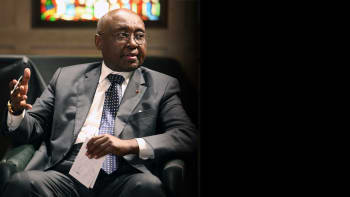
The Commission on State Fragility, Growth and Development is launched and will lead to the establishment of a Council on State Fragility, whose co-chairs are Ellen Johnson Sirleaf, former president of Liberia; David Cameron, former UK prime minister; and Donald Kaberuka (pictured), Special Envoy for the African Union Peace Fund, Rwanda’s former finance minister, and seventh president of the African Development Bank (2005–2015).
May 2017
A new partnership between the University of Oxford and the Inamori Foundation brings the Kyoto Prize Laureates to Oxford each May.
2017-18
September 2017
Alumni gather to celebrate five years of the MPP. Our five-year anniversary heralds plenty to celebrate: 12 new full scholarships are confirmed, and there’s been a 42% growth in donations for scholarships to £1.32 million, as well as an 82% growth in research income, to £3.73 million, 18 new research grants, and an almost 50% rise in researchers.
January 2018
The School is chosen by the Bill & Melinda Gates Foundation to lead a major global commission, Pathways for Prosperity, on technology and inclusive development.
The commission will go on to have a global impact, from Mongolia to South Africa.
10 May 2018
We are visited by Nobel Peace Prize laureate and female education advocate Malala Yousafzai. Other Nobel Laureates who have spoken at the School include economist Joseph Stiglitz (Nobel in Economics 2011) and former Colombian president Juan Manuel Santos (Nobel Peace Prize 2016).
2018-19
November 2018
Prime Minister of Serbia Ana Brnabić speaks at the School. Across our history we have welcomed 38 current or former presidents and prime ministers through the doors.
July 2019
We run our first Executive Public Leaders Programme for senior public sector leaders from around the world, welcoming among others New Zealand’s Director-General of Security, Jamaica’s Attorney General, and the head of the UN Technology Bank. It is the flagship in our growing set of executive programmes.
Executive Public Leaders Programme participants
Executive Public Leaders Programme participants
“Nothing short of life-changing”
2019-20
27 January 2020 (United Nations Holocaust Remembrance Day)
The inaugural Alfred Landecker Memorial Lecture is held, on ‘Political ideology in the 1930s: lessons for the 2020s’. It launches the School’s Alfred Landecker Programme, on the rights of minorities and other vulnerable people.
Meanwhile, cases of a novel coronavirus start to spread across countries…
11 March 2020
A global pandemic is declared. Rarely has the life-or-death impact of government decisions been more starkly apparent worldwide. Our research pivots to help them.
Our biggest contribution is the Oxford COVID-19 Government Response Tracker, which aims to document in real time the policy responses of every government in the world. Powered by an ever-growing team of citizen scientists, which by 2022 will number over 600 volunteers, the tracker quickly becomes a vital tool for decision-makers across the globe.
23 March 2020
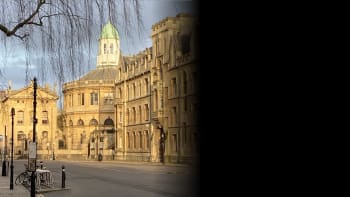
The UK goes into lockdown. The streets of Oxford are deserted.
A collaborative staff effort sees our 124 MPP students able to reconvene – from almost every major inhabited time zone – in a virtual classroom.
April 2020
We launch our suite of online courses, bringing elements of our education to those who can’t take the time to do a full degree. By 2022 we will be running four online courses and will have taught 450 people (and counting) in this way.
2021-22
In-person teaching is allowed, but under strictly spaced-out conditions, and with many students unable to travel. We perfect the hybrid classroom, with students present both in the lecture theatre and online on large screens.
September 2021
We launch the MSc, aimed at graduates who have completed our MPP or equivalent and who want to pursue a career in applied research that seeks to inform and improve public policy.
January 2021
We have our largest ever number of applications for the class of 2021 – up by a third and coming from 106 countries.
2022-23
In our 10th year….
The story of the School is playing out in multiple countries, in hundreds of ways, as our alumni and others in the ‘Blavatnik School family’ serve their own communities. Their stories show just a few examples of how the world is different thanks to them, and to what they learned at the School. Our collective story includes everyone whose lives they have touched since graduating – as humanitarians, elected politicians, senior officials, social entrepreneurs, diplomats, educators, conservationists, and leaders. And it includes everyone who has been affected, directly or indirectly, by our research and engagement.
In the broadest sense, our community includes everyone interested in good government, and we connect with wide public audiences. Good government matters to everyone, so reaching as many people as we can matters to us.
Our home
Having a building says ‘we are part of a university that has seen it all and kept going’. It’s that resilience we wanted to carry forward.
10 years of growth
We welcomed our first students in 2012. Ten years on, we look back at some key moments in our growth since then.
