
Come and film it: The journey and implications of Senate Bill 22
Texas implements new film incentive program to attract filmmakers
Hollywood has long been the capital of the film industry, but Texas is emerging as a new contender.
With the implementation of a long-term film incentive program guaranteeing $300 million each biennium for the next 10 years, the rapidly expanding Fort Worth film industry could see an uptick in productions and economic growth for the city.
However, this change did not come without its trials.
Film advocates and lobbyists worked for years at improving the Texas film industry as a whole and spent the 2025 session pushing for a new bill to secure a stronger incentives program.
Senate Bill 22 completely restructured the Texas Moving Image Industry Incentives Program (TMIIIP) and turned Texas into a more accessible location for filmmakers—a change that was years in the making.
The Build-up
Texas filmmakers faced a dilemma: produce films in Texas with little to no incentive or move production to a different state for tax credits.
A Texas native and former film student at the University of Texas at Austin, Chase Musslewhite, knows the dilemma all too well. While pursuing a career in directing after earning her M.F.A., Musslewhite said, a financier for her feature film would provide funding if she filmed in Louisiana because of their film tax credit program.
Musslewhite refused the funding to remain true to her film, which “had to be shot in Texas,” she said.
Experiencing first-hand the struggle to produce films in Texas, she put her filmmaking career on hold and co-founded Media for Texas in 2023 alongside fellow filmmaker Grant Wood “with the desire to provide unity across the industry [to] get a bill to the finish line,” Musslewhite said.
Specifically, a bill that would create a long-term film incentive program and attract projects to the state.

Chase Musslewhite, the co-founder of Media for Texas. Photo courtesy of Media for Texas.
Chase Musslewhite, the co-founder of Media for Texas. Photo courtesy of Media for Texas.

Musslewhite, Wood and friends at the Texas Film Experience. Photo courtesy of Media for Texas.
Musslewhite, Wood and friends at the Texas Film Experience. Photo courtesy of Media for Texas.
Fort Worth’s mayor, Mattie Parker, delivered her 2025 State of the City address on Oct. 16 and spent over 20 minutes on the development of the film industry. She said, “Texas has always been a place where [productions] wanted to be. The problem was we were not competitive enough when it came to incentives.”
Despite a desire to film in the Lone Star State, productions rarely considered the possibility.
“Studio films make a budget for different places, and they compare what that incentive program is going to do for them,” Musslewhite said. “Before this point, no one was making a budget for Texas.”
“Even if production teams were asked to create a budget for Texas, the plausibility of shooting in Texas was so low,” she said.
Therefore, even films set in Texas would hold production in states with better incentives and tax credits, including New Mexico, Oklahoma, Louisiana and Georgia.
Some of these projects include Ransom Canyon, The Highwaymen and Hit Man.
Musslewhite and Wood spent the next year "meeting with the [film] industry and trying to get everybody to agree...and work together to get a bill passed," she said.
Around the same time as Musslewhite and Wood's initial inspiration to improve incentives, showrunner Taylor Sheridan, a Fort Worth native and the creator of Yellowstone, had just “planted his flag down in Texas,” proving that “it doesn’t have to be Hollywood’s version of things,” Musslewhite said.
Over in Fort Worth, a booming film industry blossomed seemingly overnight with the arrival of Sheridan hand-in-hand with 101 Studios.
Dr. Tricia Jenkins, an associate film professor at TCU, said there was not a “heavy slate” of big productions shooting in Fort Worth until Sheridan decided to bring his productions home.
“He’s not just filming one TV show a year here,” Jenkins said, “he’s shooting multiple, so the change has been significant.”
Since 2021, Sheridan has filmed five different television shows in Fort Worth, a few including multiple seasons with Cowtown as the backdrop.
Sheridan's productions have filmed all over Fort Worth, including the historic Fort Worth Stockyards, Sundance Square and TCU.
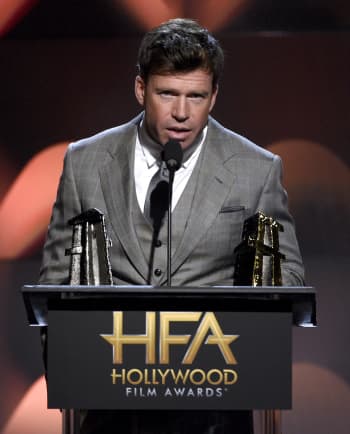

Thus, the Media for Texas campaign received overwhelming support from Fort Worth, but Musslewhite and Wood still needed “a champion inside the Capitol,” she said.
Lt. Gov. Dan Patrick became that champion.
In August 2024, Patrick attended Dennis Quaid’s Reagan premiere and declared that “he wanted to make Texas the media capital of the world,” Musslewhite said.
Also, Patrick accounted for Texans wary of Hollywood’s infiltration of their state. He wrote on his website, “We are not trying to make Texas the next Hollywood—we don’t like Hollywood. We want to export Texas values.”
The primary goal? Texas becomes the top filming location, not just in the country but in the world, Patrick said on his website.
The industry came together to push for improved incentives, producing content with stars who call Texas home to advocate to the public.
Stray Vista Studios' "True to Texas" video received over 200,000 views on YouTube.
Patrick set the tone that film incentives would be a priority for the next session, so the Media for Texas team dove into drafting language to bring to the first preliminary hearing in October 2024.
However, their champion faced a foe.
The Battle
Rep. Brian Harrison openly opposed Senate Bill 22, running his own “Don’t Hollywood My Texas” campaign.
His primary argument focused on not wanting to give taxpayers’ money to “liberal Hollywood.”
Harrison wrote on X: “Funding Hollywood movies is NOT the role of the government…But even if it were…it is an economic loser that harms taxpayers. We should be cutting taxes, not increasing them to fund Hollywood!”
Senate Bill 22 stood as an obstacle in the path of Harrison’s push to cut back property taxes.
He claimed the 2025 session might be the most “anti-taxpayer” in Texas history.
Harrison represents Ellis County, but his hometown, Midlothian, is home to The Chosen.
Even with Harrison’s campaign to keep Hollywood out of Texas, the state’s film industry came together to testify in Austin.
Sheridan spoke for two hours at the first Senate hearing about the film industry’s progress in Fort Worth, and Parker added information about the industry’s impact on the city.
Parker brought in Ross Perot, Jr., the chairman of Hillwood, to emphasize the film industry’s impact on Texas’ economy. “That’s when you knew it was different and had staying power,” Parker said.
A slew of stars spoke at the senate and house hearings, including Matthew McConaughey and Woody Harrelson, who are Texas natives that have pushed for better incentives the past few sessions.
McConaughey joked during the April 23 hearing at the House, "We're going to make t-shirts. Don't make me go to Georgia."
Senate Bill 22 passed the Senate on April 16, 2025, followed by the House on May 26, 2025.
Gov. Greg Abbott signed Senate Bill 22 into law on June 22, 2025.
While some celebrated, Harrison mourned taxpayer dollars. “This is big government liberal redistributive socialism,” Harrison told Los Angeles Times. “The governor and lieutenant governor of the supposedly Republican-controlled state of Texas chose to keep property taxes billions of dollars higher so that you can subsidize a rich liberal Hollywood movie industry—how embarrassing.”
On July 21, 2025, Harrison filed a bill to repeal Senate Bill 22 and “redirect every penny to lowering property taxes.”
Harrison did not respond to a request for comment.
Despite Harrison’s outcry, the film industry packed its bags and hopped on the first flight to the Lone Star State.
The Texas government wants to steal BILLIONS from Texans, who are already being taxed out of their homes… and give it to liberal Hollywood.
— Brian Harrison (@brianeharrison) April 23, 2025
Texas taxpayers, your government hates you.
I will do everything I can to stop this insanity. https://t.co/J7JjfE1OUp pic.twitter.com/DtDdOFAp8H
The voices heard at the initial hearing on Oct. 16, 2024 at the Texas Senate Finance Committee. Photo courtesy of Media for Texas
The voices heard at the initial hearing on Oct. 16, 2024 at the Texas Senate Finance Committee. Photo courtesy of Media for Texas
Texans - if you did not know… SENATE BILL 22 steals billions of your dollars (that should’ve been returned to you to eliminate property taxes) and gives it to rich, liberal Hollywood elites.
— Brian Harrison (@brianeharrison) August 19, 2025
The Texas government is turning us into California…
And making YOU pay for it! https://t.co/IkYpXKl0Mq
The Bill
Senate Bill 22 went into effect on September 1, 2025.
It guarantees $300 million each biennium for the next ten years, with a 5-25% base incentive determined by eligible Texas spending and multiple 1% or 2.5% stackable uplifts. Also, the incentives include up to a 31% grant rebate and lowered the residency requirements from 70% to 35%.
TMIIIP does not function off tax credits, since Texas does not have a state income tax, but rather cash grants.
Productions can receive uplifts to the base incentive for hiring Texas resident veterans, spending on in-state postproduction, filming in rural locations, producing faith-based stories, filming at historical sites or partnering with higher education institutions.
Parts of the bill are subject to interpretation, including specifics on what type of projects qualify. The Texas Film Commission encourages productions to apply or reach out to determine eligibility.
As part of their "TMIIIP on the Road" tour, members of the Texas Film Commission and TMIIIP sat down at the Lone Star Film Festival on Oct. 30 to explain the new incentives and answer questions from Fort Worth's industry professionals.
"We'll go on a case-by-case basis because we want to be in the game," Willita Mahone, Texas Film Commission's intake coordinator, said. "We want to be competitive."
Some members of Fort Worth's film scene expressed concern at new big-budget productions pushing out independent and local filmmakers.
One audience member asked about the commission's outreach efforts to bring productions to the state.
"It's beyond bringing projects here, it's also about keeping projects here," Cassandra Ariztegui, the production incentives specialist, said, "[Outreach] is kind of cultivating the relationships we have [in Texas] as well."
The long-term program provides Texas a fighting chance against its biggest competition.
No more shooting Texas-set films in the likes of New Mexico, Oklahoma, Louisiana and Georgia.
Another important element of the bill is that the funds do not expire.
Previously, leftover funds became inaccessible at the end of the biennium. Now, if the entirety of the $300 million is not spent, the excess will roll over into the next biennium, and those funds will continue to accrue interest and grow.
However, while Texas now stands a fighting chance in the United States, states are not just competing with other states but also with international locations, too.
The Benefits
Immediately, the film inquiries started rolling in.
“For the first time,” Musslewhite said, “people are actively engaging with Texas and trying to make a Texas budget work.”
Before Senate Bill 22, Fort Worth alone experienced an economic impact of $1 billion, with the film industry creating more than 50,000 jobs. These numbers are only expected to increase as more productions flow in.
“We believe that film is the next great industry in Fort Worth,” Parker said in her State of the City address. “It will become a part of the enduring economic development story that defines our city’s future.”
Parker continues to say yes to film in Fort Worth because of this economic development on local businesses, including “dry cleaners, restaurants, caterers and future job prospects.”
Additionally, Parker has hopes that productions will continue to choose Fort Worth.
“From Tim McGraw to Billy Bob Thornton,” Parker said, “I continue to hear that our hospitality is what sets Fort Worth apart.”
David Glasser, the head of 101 Studios, sat down for a Q&A with Parker during the State of the City address to highlight the growth of the film industry.
He agreed with Parker on the hospitality front. “I hear constantly from our stars that it’s about the people.”
Stars and crews want to film in Fort Worth, and Senate Bill 22 helps bankroll their stay.
The Breakthrough
Three things bring productions to an area: tax incentives, well-trained workforces and production facilities, Jenkins said.
Long-term incentives are now in place, so with the industry set to expand, the labor force will need to expand right alongside it.
The need for an educated crew base is high as productions look to hire locals to meet residency requirements, Jenkins said.
Currently located in California, 101 Studios produces Sheridan’s projects, and Glasser plans to move the studio’s headquarters to Fort Worth in 2026. He has already moved 15% of his staff to Fort Worth, he said.
With the influx of productions, Glasser knows all too well the need for local labor.
“I do not have enough jobs to fill the shows we have here,” Glasser said. “We can give more jobs to people, which gives back to the community.”
He joked at the State of the City address that he would hire audience members on the spot if they had any experience.
On a broader scale, Media for Texas is now shifting gears to strengthening the labor force for all of Texas to meet the expected increase in demand for resident labor.
Media for Texas is now working on collaborations with universities through a student ambassadorship program to help provide on-set learning opportunities. In return, productions receive a 2.5% uplift for working with students.
In Fort Worth, the film student experience has evolved.
Red Sanders, the owner of Red Productions and current board chair of the Lone Star Film Society, graduated from TCU in 2004.
Parker, who works closely with Sanders, said, “When I first met Red, he would say ‘Man, I would’ve given anything coming out of TCU to just stay right here.’”
Sanders started his career in Los Angeles before returning to Fort Worth to build his studio.
“Now if you’re Red Sanders graduating from TCU,” Parker said, “you get to stay right here, and you can go work for someone like David Glasser and learn from some of the very best in the business.”
TCU film students shadowed Sheridan’s productions and multiple found work immediately post-graduation with Glasser’s 101 Studios, Jenkins said.
“I know of at least seven or eight students who have come out of our program in the last three years who have all been hired by 101 Studios, and before that wasn’t possible,” Jenkins said.
101 Studios works with TCU as an industry partner to help train students on volume studios, Jenkins said, providing students with connections and access to facilities they have never had before.
The Fort Worth Film Collaborative also works with 101 and the Fort Worth Film Commission to train students on in-demand industry skills, awarding different certificates at the conclusion of the program.
The Fort Worth Film Commission and Film Collaborative did not respond to requests for comment.
In Fort Worth, Ross Perot, Jr.’s company Hillwood is currently working closely with 101 Studios to build a soundstage facility, and the stages are available to any production that wants to rent the studio, Jenkins said.
SGS Studios, the soundstage facility, in Alliance is the largest operating production studio in Texas. The 450,000-square-foot studio spans across two separate campuses.
Texas has the locations, the labor and the incentives all prepared.
The long-term incentives are forecasted for success, but the program is not perfect.
The residency requirement for above-the-line talent has been a recent talking point, Musslewhite said.
Above-the-line talent comprises a large part of a film’s budget, so if actors are not residents, they cannot be qualified for incentives.
“If we don’t qualify any of those people, it will be hard still to compete with Georgia,” Musslewhite said. “What we would look to in the future is how to qualify at least five talent above the line. That’s step two.”
For now, Musselwhite will celebrate the victory of Senate Bill 22, and Texas will welcome new productions.
In 10 years, the Texas film industry will reap the benefits of the $1.5 billion guaranteed by Senate Bill 22.
Ultimately, Texas' long-term incentives program encourages productions to "come and film it."
