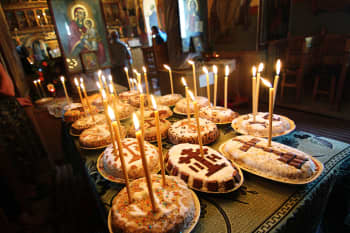
‘I feel robbed’: Greek community of Australia raise questions about Greek Orthodox Archdiocese's newly formed death and funeral certificate
By Pamela Rontziokos
Concerns about the necessity of the Greek Orthodox Archdiocese of Australia's newly formed death and funeral service certificate have been raised in the Greek community of Australia, according to an investigation by The Greek Herald.
Known officially as a 'Certificate of death and funeral service' for the Greek Orthodox Archdiocese, the certificate was introduced at the start of the 2022 financial year, July 1, and will bring over $1 million into the Greek Orthodox Archdiocese annually.
An encyclical issued by the Greek Orthodox church and seen by The Greek Herald, explains Archbishop Makarios of Australia and bishops under him decided unanimously,
"To issue, after each funeral service, a funeral certificate, at the request of many of our faithful, for cases relating to inheritance for which there must be proof of identity (especially, when the name has changed for the Australian state)".
The Greek Herald has since disproved this statement, as Australian probate solicitors confirm the $250 'Certificate of death and funeral service' is not a legally recognised document and therefore cannot be used to prove identity for inheritance or in the process of probate in Australia.
Subsequently, Greek probate solicitors confirm the certificate is not needed for proof of identity in cases relating to inheritance in Greece.
It is not recognisable by the Consulate General of Greece in Australia too, which only requires a death certificate from Australian state authorities to register the death of an individual with Greek citizenship.
In fact, the newly formed certificate,
which is a “Sacredly sealed and Signed Hierarchical Letter”,
does not say the individual died, rather they "fell asleep in the Lord on the...day of...".
In this case, the Greek Orthodox Archdiocese certificate is not a legal death certificate as it only records a Greek Orthodox funeral service and confirms an individual's death to God.
In Australia, no other dominate religious groups have such a certificate. The United Church of Australia, Catholic and Anglican churches, as well as Islamic faith all rely on state government death certificates.
Louise Mileto, a primary school teacher from Sydney, recently managed the funeral costs for her late father. The 40-year-old told The Greek Herald in an interview her concerns about the high cost of the certificate after being billed $250 by the Greek Orthodox Church.
“I was shocked. I'm like, why? What is this?”
“What purpose is to basically say your father's declared dead on this day under the church,” she said.
“What's that going to do for me?”
A source from the funeral home industry, who has asked for their name to be withheld and collects the $250 fee, also said to The Greek Herald many families have the same perspective as Louise and question the certificate but end up paying to avoid conflict.

Louise Mileto with her father John Tzannes and sister, Adele Tzannes. Photo: Supplied.
Louise Mileto with her father John Tzannes and sister, Adele Tzannes. Photo: Supplied.
“All of our families have that sideways look like, ‘What's this all about?’ And I don’t blame them and they pay it because it has to be paid,” the funeral home director said.
The Greek Orthodox Archdiocese, which has an active website and social media presence, updates the community with messages, but the newly formed certificate was never announced.
Rather the new certificate was only informed to funeral home directors and churches, who are now consequently responsible for explaining the certificate to the Greek Orthodox community.
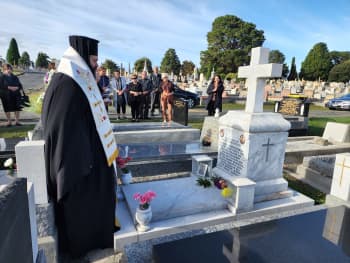
High cost of 'Certificate of death and funeral service'
For a certificate that is only recognised within the church, the $250 cost is significantly higher and in some cases five times the amount compared to a death certificate legally recognised in Australia and Greece.
Across Australia, prices vary for a legal death certificate from state governments. Yet the lowest price of a death certificate is $49 in Northern Territory and the highest $85 in Victoria - a figure still largely lower than the Greek Orthodox Archdiocese certificate.
A Greek death certificate is similarly inexpensive, costing 30 Euros which is $49.50 AUD (according to the exchange rate in April 2023).
"Well, there's only one explanation for it,” the funeral home director said. “To build revenue”.
"No other church in Australia charges families for a certificate, not one other religion in all of Australia charges this," they added.
Louise Mileto says the new certificate is unjustified and unfair.
“I feel robbed,” she says.
“All these families who can't afford everyday groceries for their families, then now can't even afford to bury their loved ones,” she said.
Waiving of the fee is another area of concern, according to the funeral home director, as those with questions or difficulties about the certificate speak to their Parish priest who then makes new arrangements.
How the church determines who is eligible for waiving is unknown, however it is clear some families are not paying the $250 while others are.
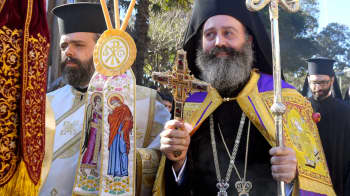
'Certificate of death and funeral service' worth over $1 million
Until July 1, 2022, Greek Orthodox funeral payments went directly to the church where the funeral was held, paying for the priest, chanters, altar boys, etc., for an approximate fee of $650.
Since the certificates’ introduction, Greek Orthodox funerals cost families $900 , with the Greek Orthodox Archdiocese profiting from the $250 added cost.
Through the examination of an Australian Institute of Health and Welfare report, The Greek Herald determined an official estimate the Greek Orthodox Archdiocese of Australia would collect from the new document in a period of 15 months.
Released in August 2022, the report exhibited there were 1,214 deaths (of Greek Orthodox people) per 100,000 in the Australian population for the period August 2016 and November 2017.
Notedly, the graph included only those who could be linked between two government datasets and does not include those who could not be linked between these two datasets. This means the number of deaths of people identifying with the Greek Orthodox religion could be higher.
From this official government data, The Greek Orthodox Archdiocese will approximately earn 1.8 million dollars, in a period of 15 months.
Many members of the community like Lousie, are curious about where the money is going. “Where is the money going to?” Louise Mileto questioned.
“Give us proof," she said.
For a religious organisation serving 390,961 people, according to the 2021 ABS, there is a palpable feeling of unease about the document, which is only presented to family members when they are grieving their loved one.
“Why do you have to put families through so much? You know, we're mourning the death of a loved one,” Louise said.
Not only do families struggle to pay for the document and understand it's use, but questions linger in the Greek community about Greek Orthodox people who died before July 1 2022, and whether their Greek Orthodox funeral and death are recognised by the Greek Orthodox Archdiocese.
At current it is known the Greek Orthodox Archdiocese does not hold any formal records before July 1 which documents the deaths of Greek Orthodox people in Australia.
“How they are going about with everything, in general, is turning the younger generation away from the church,” Louise said emotionally.
“Church is about people - it's a congregation of people and we don't have a voice,” Louise says.
“Our voice is only the voices of the hierarchy - they determine the rules, not us.”
The Greek Orthodox Archdiocese of Australia has been contacted for comment.